Last updated October 9, 2026
Room Addition Contractor Warning Signs Every Homeowner Should Know
Here’s the thing most Los Angeles homeowners don’t realize until it’s too late: the contractors who cause nightmares don’t usually make bad pitches. They make good ones. The warning signs live somewhere less glamorous, in the down payment they request before any permit exists, in the crew they never introduce by name, in the payment schedule that quietly hands them all the leverage by the time the framing inspection rolls around. This guide walks through the signals that actually predict trouble, drawn from nearly two decades of building ADUs and room additions in Los Angeles. You’ll learn what the state of California says about down payments, why “we can skip the permit on this part” is the most expensive sentence a contractor can say to you, and how to verify insurance the way an underwriter would.
Quick Answer
The clearest warning signs of a bad room addition contractor in Los Angeles are: asking for more than 10% or $1,000 down (whichever is less) before pulling a permit, suggesting any part of the project skip permitting, refusing to provide the names and photos of the crew who will have extended access to your home, front-loading the payment schedule so you’re 70% paid before the work is halfway done, and being unable to produce a certificate of insurance that names your property. Any one of these is a serious flag. Two or more means walk away.
Table of Contents
- 1. The Down Payment Test: What California Law Actually Says
- 2. The Permit Red Flag: Why “Skip It” Transfers Risk to You
- 3. The Crew Identity Problem: Who Has Access to Your Home
- 4. Payment Schedule Manipulation: The Silent Leverage Play
- 5. Verifying Insurance: Don’t Take Their Word for It
- 6. Contract Clauses That Signal Trouble
- 7. Change Order Chaos: The Scope Creep Warning
- 8. Common Mistakes to Avoid
1. The Down Payment Test: What California Law Actually Says
If a contractor asks for more than 10% or $1,000 as a down payment before pulling a permit in California, whichever is less, they are asking you to break state law with them. That’s not an opinion. It’s the rule under the California Contractors State License Board, and it applies to every residential project, including room additions in Los Angeles. A contractor who cites this law, respects it, and structures their payment schedule around it is telling you something about how they treat every other rule on your project. A contractor who hand-waves it, says “that’s just a formality,” or asks for 30% “to lock in materials,” is telling you something too.
Here’s why this matters more than the dollar amount. The down payment rule exists to protect homeowners from exactly the kind of contractor who collects a fat deposit, starts the job, and then disappears or slows to a crawl. A contractor who won’t work within that rule is either ignorant of the law they’re licensed to operate under, which is a competence red flag, or they know the law and don’t care, which is a character red flag. Neither one gets better once the foundation is poured.
In Los Angeles, where the average room addition runs anywhere from $120,000 to $260,000 depending on square footage, finishes, and site conditions, a 10% deposit is already a meaningful sum-something we cover in our ADU Builders Maintenance Schedule: What to Do and When. There is no legitimate reason to ask for more before a permit is filed. If you hear “material costs are up,” or “I need to secure my crew,” that’s a contractor managing their cash flow on your back. Builders who are financially stable quote a price, take the legal deposit, pull the permit, and bill in milestone increments tied to completed, inspected work.
We’ve always operated this way at Sutton ADU Builders. The written price comes first, the deposit stays within the legal limit, and no tool gets lifted before the permit is in hand. It’s not a sales tactic. It’s the baseline for how a professional runs a project in this city.
2. The Permit Red Flag: Why “Skip It” Transfers Risk to You
The most expensive sentence a room addition contractor can say to you in Los Angeles is some version of this: “We can skip the permit on this part. It’ll save you money and time.” What that sentence actually means is: “I’m transferring legal, financial, and insurance risk onto you, permanently.” Unpermitted work on a room addition doesn’t age out. It follows the property. When you sell, the buyer’s inspector finds it. When you file an insurance claim after an earthquake or water event, the adjuster finds it. When the Los Angeles Department of Building and Safety gets a complaint from a neighbor, the inspector finds it. And every time, the person holding the bag is you, not the contractor who pocketed the savings.
Room additions are not like swapping a faucet. They require structural changes, electrical work, HVAC extensions, and often foundation work. Each of those trades needs its own permit and inspection in Los Angeles. A contractor who suggests skipping any of them is asking you to accept a structure that has never been verified as safe to occupy. That’s a risk no amount of upfront savings justifies.
There’s also the insurance angle. If unpermitted work causes a fire or a structural failure, your homeowner’s insurance carrier has grounds to deny the claim. That’s not hypothetical. Insurers in California have become aggressive about unpermitted additions, especially in areas with older housing stock. The contractor who told you not to worry won’t be the one writing the check. You will be, out of pocket, potentially for hundreds of thousands of dollars in remediation and code corrections.
A legitimate Los Angeles room addition contractor pulls every permit the project requires, schedules every inspection, and treats the permit process as part of the service, not an obstacle to be engineered around. If a builder’s selling point is speed and secrecy on permits, that’s not convenience. That’s a warning sign in a hard hat.
3. The Crew Identity Problem: Who Has Access to Your Home
A room addition is not a one-day project. It’s weeks or months of people entering your home, your garage, your backyard, often while you’re at work or your kids are home alone. In Los Angeles, where room additions can run four to eight months from groundbreaking to final inspection, that’s a significant stretch of time to have strangers on your property. Yet most contractors never tell you who those people are. You get a project manager’s name, maybe a lead carpenter, and after that it’s a rotating cast of unnamed subcontractors.
That’s a safety question, but it’s also a liability question. If something goes missing, if a door gets left unlocked, if someone gets hurt on your property, do you know who was on site that day? Do you have a record? Most homeowners can’t answer that, because their contractor never gave them one.
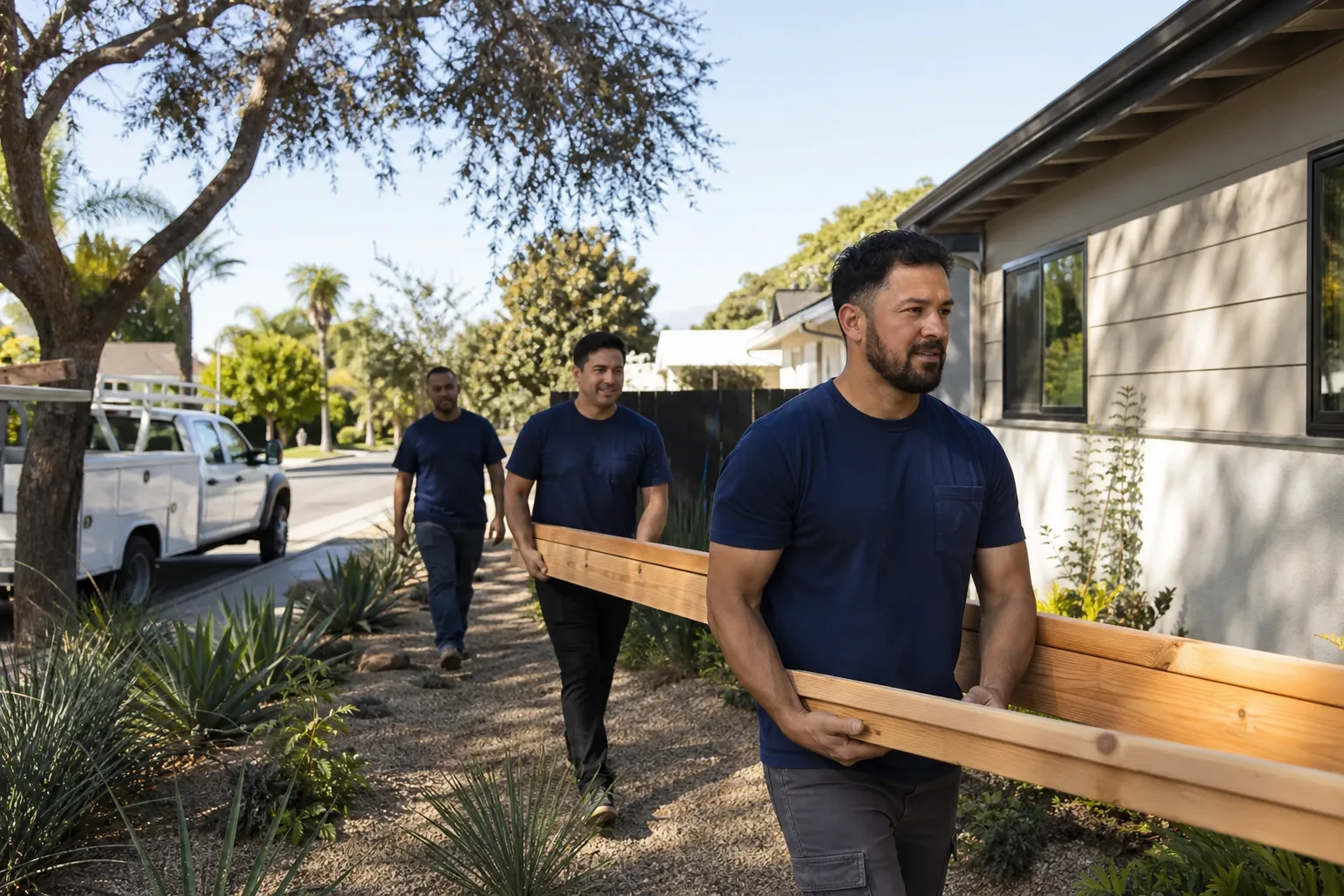
The Threshold Standard, which Sutton ADU Builders operates under as part of the Threshold Group, was built to solve exactly this problem. Every technician who works on your project is background-checked and identity-verified. Before they arrive, you get their name and photo. When they show up, they’re in a clean, marked uniform and they present a photo ID badge at the door. Every time. Not just the project manager. Everyone.
In our experience, most Los Angeles homeowners don’t know to ask for this until after something goes wrong. But it’s a completely reasonable thing to ask any contractor. “Who exactly will be on my property, and how will I know they’re supposed to be there?” A good contractor answers that question with specifics. A bad one deflects with “don’t worry, my guys are great.”
4. Payment Schedule Manipulation: The Silent Leverage Play
Most homeowners scrutinize the total price and skim the payment schedule. That’s backwards. The payment schedule is where a bad contractor gains leverage over you, and the most common scheme is front-loading. Here’s what it looks like: 25% at contract signing, 25% at demolition, 20% at framing, 15% at rough-in, and the remaining 15% spread across drywall, finishes, and final inspection. Add it up and you’re 70% paid by the time the framing inspection passes. The structure is barely a shell. You now have no financial leverage to make the contractor finish the job well, or finish it at all.
The proper structure ties every payment to completed, inspected milestones that leave you holding meaningful dollars until the end. A reasonable schedule might look like this:
- 10% or $1,000 (whichever is less) at contract signing, before permits are pulled, as California law allows.
- 15 – 20% at foundation and slab completion, with inspection passed.
- 20 – 25% at framing and rough-in completion, with inspection passed.
- 20 – 25% at drywall, interior finishes, and cabinetry installation.
- 10 – 15% at final city inspection and punch-list completion.
- 5 – 10% retention held for 30 days after project completion to cover any latent defects.
That structure keeps both parties honest. The contractor has enough cash flow to keep the project moving, and you have enough held back that it’s cheaper for them to finish properly than to walk. If a contractor in Los Angeles pushes back on a schedule like this, especially on holding retention, that’s a signal they expect problems at the end that they’d rather you pay for upfront.
At Sutton ADU Builders, every project gets a written price before work begins, and the payment schedule is laid out in the contract with no ambiguity. The 365-Day Done Right Promise covers defects in workmanship for one full calendar year from project completion. If something isn’t right, we make it right. That’s easier to stand behind when no one’s been paid for work that isn’t finished.
5. Verifying Insurance: Don’t Take Their Word for It
Every contractor will tell you they’re insured. Most homeowners accept that statement and move on. That’s a mistake, because “insured” can mean a policy that lapsed six months ago, a policy with a $50,000 limit on a $200,000 addition, or a policy that covers the contractor’s office but not your property. In Los Angeles, where room additions involve real structural work and real injury risk, verifying insurance properly is not optional.
Here’s the verification process, step by step:
- Ask for a certificate of insurance directly from the contractor’s insurance agent, not from the contractor. A certificate that comes straight from the agent’s office is harder to fake than one printed from a template.
- Confirm the policy is active and the dates cover the full span of your project. Policies lapse in the middle of long projects more often than you’d think.
- Confirm your name and property address are listed as an “additional insured” and “certificate holder.” This is the part most people miss. Without your name and address on the certificate, you’re not actually covered by their policy for claims arising from your project.
- Check the coverage limits. General liability should be at least $1 million. For larger additions with multiple crews, $2 million is not unreasonable. If a contractor hesitates to show limits, that’s an answer.
- Verify workers’ compensation coverage. In California, contractors with employees are required to carry workers’ comp. If a worker gets hurt on your property and there’s no workers’ comp, your homeowner’s insurance can be pulled into the claim.
A legitimate Los Angeles room addition contractor provides this documentation without being asked twice. At Sutton ADU Builders, insurance documentation is standard practice, because the Threshold Standard requires it. If a contractor treats your request for proof as an insult, you’ve learned something useful about how they’ll handle every other accountability question during your project.
6. Contract Clauses That Signal Trouble
Before you sign anything, read the clause that says how disputes get resolved. In our experience, that’s the single most predictive paragraph in any Los Angeles room addition contract. A fair contract says disputes go to mediation first, then arbitration or small claims court, and both parties agree to follow California contractor law, including the California Contractors State License Board’s complaint process. A warning-sign contract says disputes go to binding arbitration with an arbitrator the contractor chooses, or it says nothing at all about disputes, or it includes a waiver of your right to file a CSLB complaint.
Here are specific contract red flags we tell every homeowner to watch for:
- No start date or completion date. A contract that says “work to begin upon schedule availability” is not a contract. It’s a permission slip. Los Angeles room additions already face weather delays and permitting timelines. Your contract should still include a defined start window and a realistic completion estimate.
- Vague scope descriptions. “Build room addition as discussed” is not a scope. It’s an invitation to renegotiate every finish, outlet, and window in month three. A real scope lists dimensions, materials, finishes, fixtures, and what’s included versus excluded.
- An arbitration clause naming the contractor’s preferred arbitrator. This creates an asymmetric situation where the arbitrator has a financial incentive to keep the contractor happy across multiple cases. Mediation first, neutral arbitration only if mediation fails.
- A clause waiving your right to file a complaint with the CSLB. You cannot contract away your legal rights in California, but a contractor who asks you to is showing you who they are.
- No mention of permits or inspections. If the contract doesn’t say who pulls permits and who schedules inspections, assume the answer is “you, eventually, when the city finds out.”
A clean contract from a professional builder covers all of this without drama. The Sutton ADU Builders approach is a written price before any work starts, a defined scope, a defined schedule, permits pulled, inspections passed, and the 365-Day Done Right Promise in writing. That’s what a contract should feel like: clear enough that a reasonable person could enforce it without a lawyer.
7. Change Order Chaos: The Scope Creep Warning
Change orders are normal on a room addition. You discover a rotted sill plate when the walls come open. You decide halfway through that you want a larger closet. Those are legitimate changes, and they should be handled with a written change order that states the new cost and the new timeline before the work changes. What’s not normal is a contractor who treats every surprise as an opportunity to bill you at unofficial rates, or who starts work before you’ve approved the cost.
Here’s how to distinguish normal change management from scope creep:
- Normal: “We found termite damage in the existing wall. Here’s a written change order with the cost to repair. Sign it and we’ll proceed.”
- Warning sign: “We had to fix some stuff back there. I’ll add it to the final bill.”
- Normal: The change order comes before the work, in writing, with a specific dollar amount.
- Warning sign: The work happens first, then a vague cost appears later with no documentation.
The reason this matters in Los Angeles is the scale of the numbers. A $4,000 unapproved change order on a bathroom remodels feels messy. The same behavior on a $200,000 room addition feels like theft. A contractor who handles change orders properly is protecting both of you. One who doesn’t is testing how much they can extract before you push back.
8. Common Mistakes to Avoid
- Choosing the lowest bid without comparing scope. In Los Angeles, a bid that’s 30% below the competition is usually a scope gap, not a bargain. Compare what’s included, what’s excluded, and what’s assumed before you compare price. The cheapest bid often becomes the most expensive project once the change orders start.
- Believing a verbal promise that isn’t in the contract. “We’ll match that tile price” or “I’ll have my crew come back and touch that up” means nothing if it isn’t written. If it matters to you, it belongs in the contract.
- Skipping the reference check because you like the salesperson. Call the last three clients. Ask if the project finished on schedule, if the crew was the same one promised, and if the final bill matched the contract. Los Angeles is a big city, but it’s a small industry. Good contractors have references who are happy to talk.
- Not checking the CSLB license status before signing. The California Contractors State License Board has a free online lookup. Check that the license is active, that it’s in the name of the company you’re contracting with, and that there are no pending disciplinary actions. Do this before you sign, not after.
- Accepting a crew you’ve never met for a multi-month project. You’ll be giving these people access to your home while your kids are there. Knowing their names and faces before they arrive is not an unreasonable ask. It’s a basic safety standard.
- Paying too much before the work is done. If you’ve paid 70% before the framing inspection passes, you’ve lost your leverage. Keep meaningful money held back until the final inspection is signed off.
- Assuming “licensed and insured” means your property is covered. It doesn’t, not unless your name and address are on the certificate of insurance. Ask for the certificate and read it.
When to Call a Professional
If you’re reviewing a contract and the down payment exceeds the legal limit, walk away. If a contractor suggests skipping permits on any part of your room addition, end the conversation. If you can’t get a straight answer about who will be on your property or whether your address is on their insurance certificate, that’s your cue to keep looking. The good news is that Los Angeles has no shortage of qualified builders who pass every one of these tests, and you can find more guides & resources to help you vet them. Sutton ADU Builders offers free estimates in Los Angeles, grounded in the Threshold Standard: a written price before work begins, a 365-Day Done Right Promise on workmanship, and a crew you know by name and photo before they arrive. Call (472) 248-8213 to schedule yours.
Frequently Asked Questions
California law caps the down payment for residential construction at 10% of the total project cost or $1,000, whichever is less. This applies before the permit is pulled. Any contractor in Los Angeles who asks for more is violating the Contractors State License Board’s rules. Call (472) 248-8213 if you want a free estimate structured around a legal payment schedule.
No. Unpermitted room additions in Los Angeles create permanent legal and financial risk for the property owner, including insurance claim denials, failed home sales, and City enforcement requiring costly remediation. A reputable contractor pulls every required permit and schedules every inspection. The savings from skipping permits are never worth the long-term liability.
Request a certificate of insurance directly from the contractor’s insurance agent, confirm the policy is active, and verify that your name and property address are listed as additional insured and certificate holder. Without your name on the certificate, the contractor’s insurance does not actually protect you. Call (472) 248-8213 and we’ll walk you through the process during your estimate.
A fair schedule ties payments to completed, inspected milestones and holds back 5 – 10% retention for 30 days after final inspection. Avoid schedules that have you 70% paid before framing is done. The final payment should not be due until the city inspection passes and the punch list is complete.
Most room additions in Los Angeles run four to eight months from permit approval to final inspection, depending on scope, site access, and the city’s inspection scheduling. A realistic contractor gives you a defined start window and a completion estimate in the contract, not a vague promise. Sutton ADU Builders provides written schedules as part of every estimate at (472) 248-8213.
We operate under the Threshold Standard: every technician is background-checked, identity-verified, uniformed, and photo-badged, and you get their name and photo before they arrive. Every project gets a written price before work begins, and the 365-Day Done Right Promise covers workmanship defects for a full calendar year from completion. We’ve been building in Los Angeles since 2006, and we work with leading product lines like Abodu, Cover, Dvele, and Mighty Buildings for homeowners considering prefab options. For ongoing upkeep tips, see our Seasonal ADU Care for Los Angeles: Year-Round Homeowner’s Guide. Call (472) 248-8213 for a free estimate.
The Bottom Line
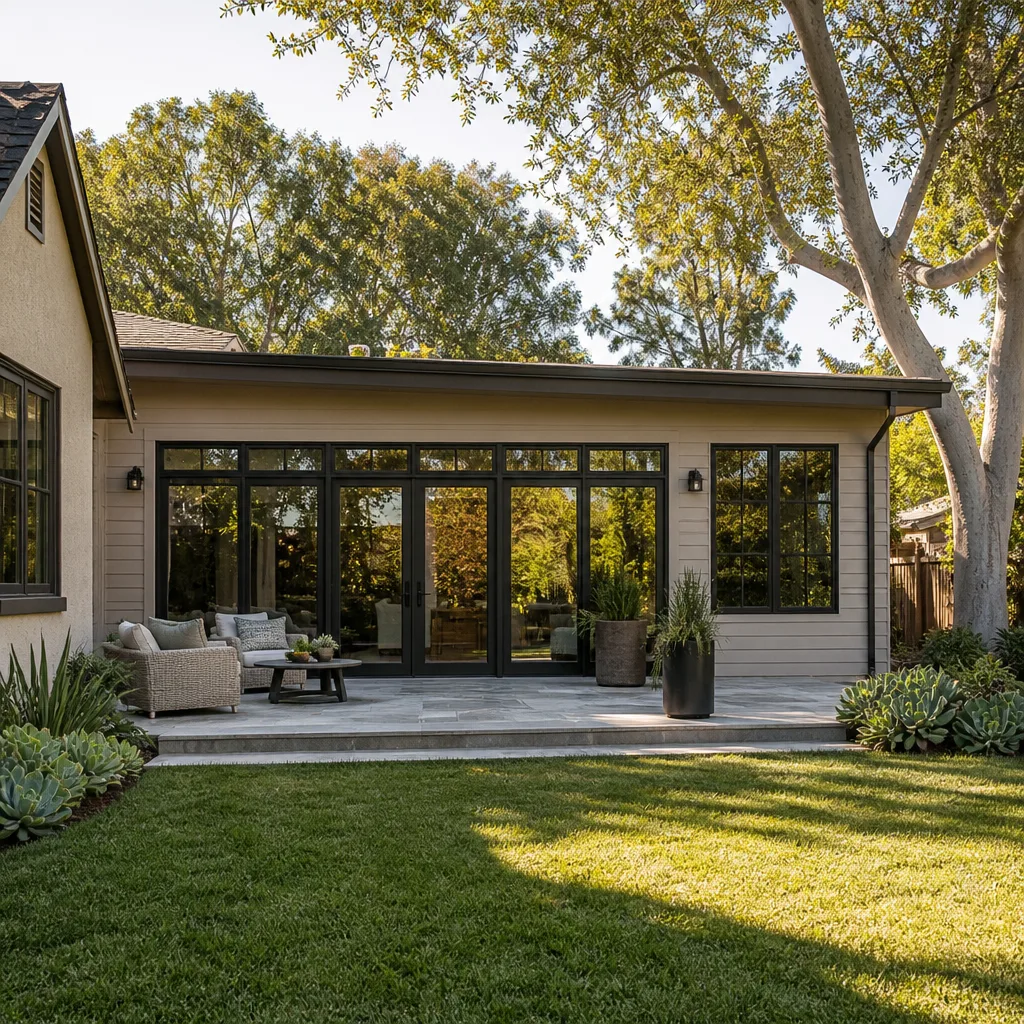
The warning signs that a room addition contractor will cause problems aren’t hiding in their sales pitch. They’re in the contract they hand you, the crew they send without introduction, the payment schedule they propose, and the insurance certificate they hope you never read. In Los Angeles, where room additions regularly run into six figures and take the better part of a year, the cost of ignoring these signals is measured in dollars and trust. Ask for the names of the people who’ll be on your property. Read the down payment clause against what California law actually allows. Verify the insurance with your own eyes. A contractor who welcomes those questions is the one worth hiring. If you’d like to see what that looks like in practice, our home addition team in Los Angeles is a good place to start. We’ve also written extensively about ADU construction in Los Angeles if you’re weighing a detached unit instead. For room-specific guidance, see our room addition services. And you can always reach us through the Sutton ADU Builders home page. Call (472) 248-8213 for a free estimate, and we’ll walk you through a written price before a single tool is lifted.
Written by Miles Hartwell, Owner at Sutton ADU Builders, serving Los Angeles since 2006.