
Room Addition Contractor: Repair or Replace? How Los Angeles Homeowners Decide
Most Los Angeles homeowners don’t actually have a repair problem. They have a decision problem: does the existing room get fixed, or does it get torn down and rebuilt? The honest answer depends less on how the room looks and more on what’s behind the drywall, what’s holding up the roof, and what the city will require once you pull a permit. If you’d rather skip the detective work and get a straight answer, call (472) 248-8213 and we’ll walk you through it.
Here’s what we’ve learned after nearly two decades of building and rebuilding rooms across Los Angeles: a surprising number of homeowners spend $8,000 to $15,000 repairing a room, only to discover during their next permitted project that those same walls needed to be opened up anyway for seismic retrofitting. That’s a sequencing mistake. A single pre-project structural assessment, usually under $500, would have caught it before the first coat of paint went on.
Before You Call a Contractor, Pull These Two Documents
The repair-versus-replace decision gets dramatically easier when you have two documents in hand before any room addition contractor in Los Angeles walks your property. Neither requires a contractor to obtain. Both are under your control.
First, your home’s original permitted plans. If your place was built or significantly altered after roughly 1960, the Los Angeles Department of Building and Safety (LADBS) likely holds a record set. You can request them online through LADBS’s records portal, and in many cases a property owner can obtain copies directly. These plans tell you what was legally built: where the load-bearing walls are, where the original footings sit, what the approved roofline was. Without them, any contractor is guessing, and a guess that’s wrong by six inches can move your project budget by five figures.
Second, a foundation inspection report. This one costs money, typically $300 to $600 in the Los Angeles market, but it’s the single most honest document in the whole decision. A structural engineer or a foundation specialist will crawl the perimeter, check for cracks, measure settlement, and tell you whether the concrete under that room is doing its job. We’ve had clients in Silver Lake who assumed their 1920s bungalow just needed cosmetic work, and the foundation report showed 4 inches of differential settlement. Repairing that room would have been throwing money into a hole, literally.
The Los Angeles Trigger Most Homeowners Miss: Pre-1980 Seismic Rules
Here’s the part that catches people off guard. In Los Angeles, if your home was built before 1980, you may be required to complete a seismic retrofit as a condition of your addition permit. The city’s mandatory retrofit ordinances started with soft-story apartment buildings, but the trigger that matters for single-family homes is the cripple-wall and foundation bolting requirements.
What this means practically: you might budget $40,000 to repair an existing room, pull a permit because the scope of work triggers one, and then learn from LADBS that the permit can’t be issued until the whole structure’s cripple walls are braced and bolted. That’s not a contractor upcharge. That’s a code requirement, and it can add $8,000 to $20,000 to a job that started as a simple room refresh.
This is exactly why the foundation inspection report matters before you spend money on cosmetic work. If you know going in that a retrofit is coming, the repair-versus-replace math shifts. You might choose to replace the room now, open the walls once, do the retrofit once, and never touch it again. Or you might decide the room is fine and the retrofit is a separate project for a different year. Either way, it’s a decision made with eyes open.
Repair Makes Sense When: The Cosmetic-Only Checklist
Some rooms are worth repairing. Not every creaky floorboard means a structural problem. Here’s the checklist we use with Los Angeles clients to identify when a repair is genuinely the right call:
- The foundation report comes back clean. No significant cracks, no active settlement, no water intrusion at the perimeter.
- The original permitted plans show an intact structure. The walls you want to open aren’t load-bearing, or if they are, the existing headers and footings are adequate for the current span.
- The electrical panel has capacity. If you’re repairing a room and adding a couple of outlets, your existing panel might be fine. The problem comes when you want a home office with a heat pump and an EV charger in the garage.
- The roof above the room is in good condition. A repair doesn’t make sense if the roofing membrane has five years left and you’ll need to redeck anyway.
- The room’s use isn’t changing. Repairing a bedroom to stay a bedroom is straightforward. Converting that same bedroom into a laundry room with plumbing and a 240V dryer line is not a repair anymore.
When all five boxes check, repair is almost always the financially rational choice. You’ll spend $15,000 to $45,000 on a typical Los Angeles room refresh, depending on finishes, and you’ll get another 10 to 15 years out of the space without touching the structure.
Replace or Add On When: The End-of-Life Signals
Replacement, or adding onto the existing footprint instead of repairing it, makes sense when the structure itself is done. Here are the signals we’ve learned to recognize, and they usually show up together:
- Footings are undersized for current code. Older Los Angeles homes often have footings that don’t meet today’s seismic standards. If you’re opening walls anyway, replacing the room lets you pour new footings once instead of patching around old ones for the next 30 years.
- The electrical panel is maxed. Many homes in Los Angeles built before 1990 have 100-amp service. A room replacement that includes new circuits, an EV charger, or a heat pump will need a service upgrade. That’s a $4,000 to $8,000 line item, and it’s better done as part of a replacement than as a surprise add-on to a repair.
- Water has been in the walls. If you’ve had a roof leak, a plumbing leak, or a window leak that sat for months, the studs and plates are likely compromised. Dry rot in Los Angeles is more common than people think, especially in coastal areas like Venice and Mar Vista where marine layer moisture hangs around.
- The room’s layout doesn’t work anymore. Sometimes the question isn’t whether to repair or replace, it’s whether to remove the room entirely and add something better. We’ve had clients in the Valley who planned to repair a 10-by-12 bedroom and ended up removing it to create a 400-square-foot family room addition with higher ceilings and a better connection to the backyard.
When the Real Answer Is an ADU Conversion Instead
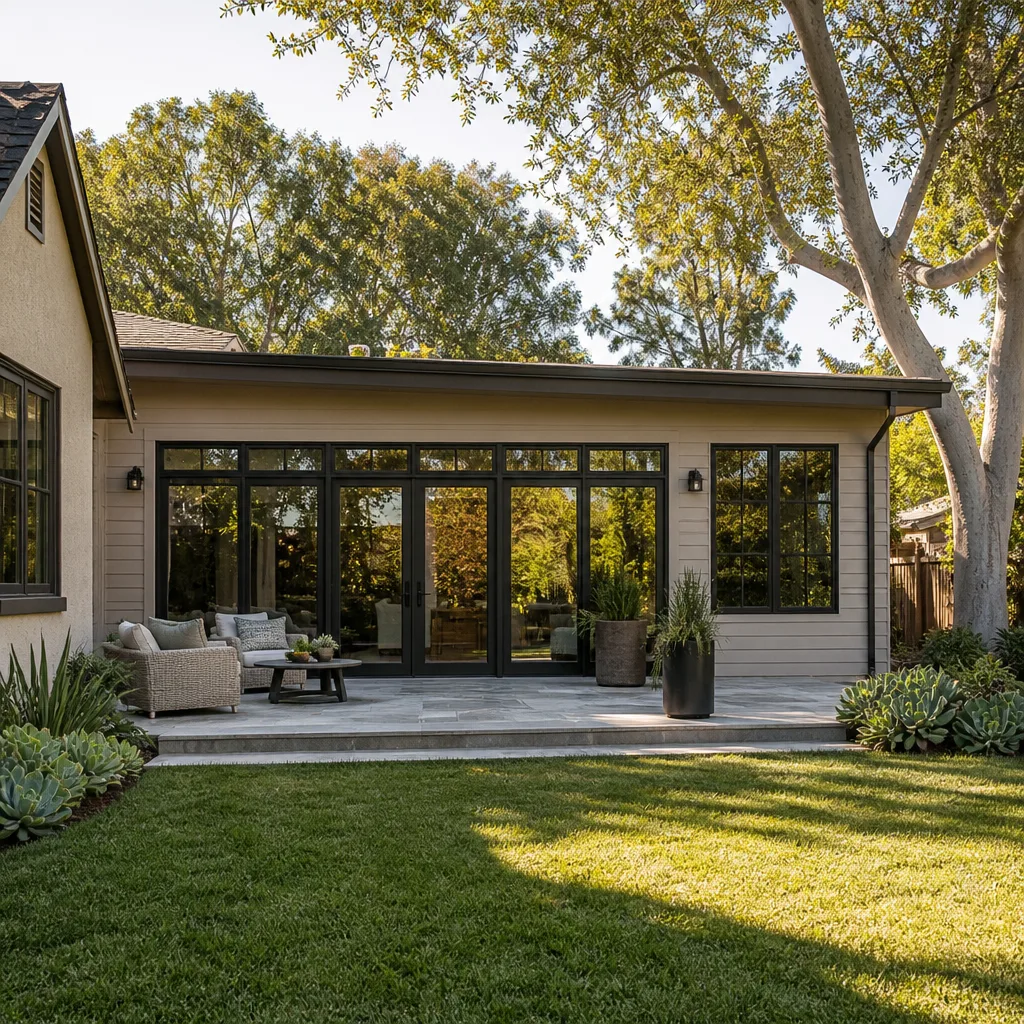
Here’s a thought that doesn’t occur to most Los Angeles homeowners until someone says it out loud: sometimes a room addition is the wrong project entirely. If you have an attached garage, you may already own the square footage you need.
Garage-to-ADU conversions are one of the most practical projects we build in Los Angeles, and the reason is simple: the four walls, the foundation, and the roof are already there. You’re not paying for new footings, new framing, or a new roofline. You’re paying for insulation, drywall, plumbing, electrical, a bathroom, and a small kitchen. The per-square-foot cost runs significantly lower than building a detached addition from scratch, often 30 to 40 percent less.
We work with prefab and modular ADU brands like Boxabl and Plant Prefab when a client wants a faster build with less on-site disruption, and we’ve used James Hardie siding systems on converted garage exteriors in neighborhoods where HOA rules restrict stucco. The honest guidance we give is this: before you spend money repairing a room you might not even need, check whether that garage or that unused side yard could become the space you actually want. You can learn more about the options on our ADU builders in Los Angeles page.
How to Get an Honest Repair-or-Replace Opinion
You need a contractor who has no financial incentive to push you toward the bigger project. That’s harder to find in Los Angeles than it should be. Here’s how we recommend approaching it:
- Ask for the two documents first. If a contractor gives you a price without asking about your permitted plans or your foundation condition, that’s a red flag. They’re pricing the easy version, and they’ll bill the hard version later.
- Request a written, line-item price. Not a verbal range. Not a “ballpark.” A written price that says what gets done, what materials get used, and what happens if things change once walls are open. This is our standard at Sutton ADU Builders, and it should be yours too.
- Ask what happens if the work fails. Every contractor will say their work is good. Few will put it in writing. Our 365-Day Done Right Promise says that if a defect in workmanship shows up within a full calendar year of project completion, we make it right. If you’re over in Los Angeles and a contractor can’t tell you their version of that, keep looking.
- Ask who’s coming to your door. In our experience, the most expensive mistakes happen when a company sends unvetted subcontractors. Under the Threshold Verified standard, every technician we send is background-checked, identity-verified, uniformed, and photo-badged, with name and photo delivered to you before arrival. You should know who’s in your house before they knock.
And one piece of practical advice from nearly 20 years in this business: if you’re leaning toward replacement, get the repair quote anyway. The repair quote tells you what a patch job costs, and that number becomes your baseline for deciding whether the extra spend on a full replacement is worth the extra decades of life.
Key Takeaways
- Pull your original permitted plans from LADBS and get a foundation inspection before you commit to any repair or replacement.
- If your Los Angeles home was built before 1980, a seismic retrofit may become mandatory once you pull an addition permit.
- Repair makes sense when the structure, foundation, roof, and electrical panel are all in serviceable condition.
- Replace or add on when footings are undersized, the panel is maxed, or water has compromised the framing.
- Sometimes a garage-to-ADU conversion is the smarter financial move than repairing or adding onto the house.
The Bottom Line
The repair-or-replace decision in Los Angeles comes down to this: what do your foundation, your walls, and your city permit actually allow? Get those answers first, and the rest of the decision is arithmetic. We’ve seen too many homeowners spend five figures repairing a room that should have been replaced, or replacing a room that could have been saved with a targeted fix, because nobody pulled the right documents before the drywall came off.
If you’re in Los Angeles and you want a home addition contractor who will give you a written price before work starts, tell you exactly who’s coming to your property, and back the work with a 365-day written promise, call Sutton ADU Builders at (472) 248-8213. Estimates are free. We’ll help you decide whether to repair, replace, or rethink the whole project.
Frequently Asked Questions
How much does a room addition cost in Los Angeles?
Most room additions in Los Angeles run between $180 and $350 per square foot, depending on finishes, foundation condition, and whether the project triggers seismic retrofit requirements. A typical 400-square-foot addition lands between $72,000 and $140,000. Call (472) 248-8213 for a written, line-item estimate on your specific property, it’s free.
Should I repair or replace my existing room in Los Angeles?
Repair when your foundation inspection is clean, your permitted plans show an intact structure, your electrical panel has capacity, and your roof is sound. Replace when footings are undersized, water has been in the walls, or the panel is maxed out. The two documents that answer this are your LADBS permit records and a foundation inspection report.
Do I need a permit to repair a room in Los Angeles?
Cosmetic repairs like paint, flooring, and trim typically don’t need a permit. But if you’re opening walls, moving plumbing, altering electrical, or changing the roofline, you’ll likely need one. And in Los Angeles, pulling that permit on a pre-1980 home can trigger mandatory seismic retrofit requirements.
Can a garage conversion be cheaper than a room addition?
Yes, often 30 to 40 percent cheaper per square foot, because the foundation, walls, and roof already exist. An attached garage conversion to an ADU avoids the cost of new footings and new framing. We’ve built these across Los Angeles, and the savings are real. Call (472) 248-8213 if you’d like us to look at your garage and give you an honest comparison.
Written by Miles Hartwell, Owner at Sutton ADU Builders, serving Los Angeles since 2006.
Need ADU Help?
Call Sutton ADU Builders - licensed & insured, here with fast after-hours help in Los Angeles.
(472) 248-8213