
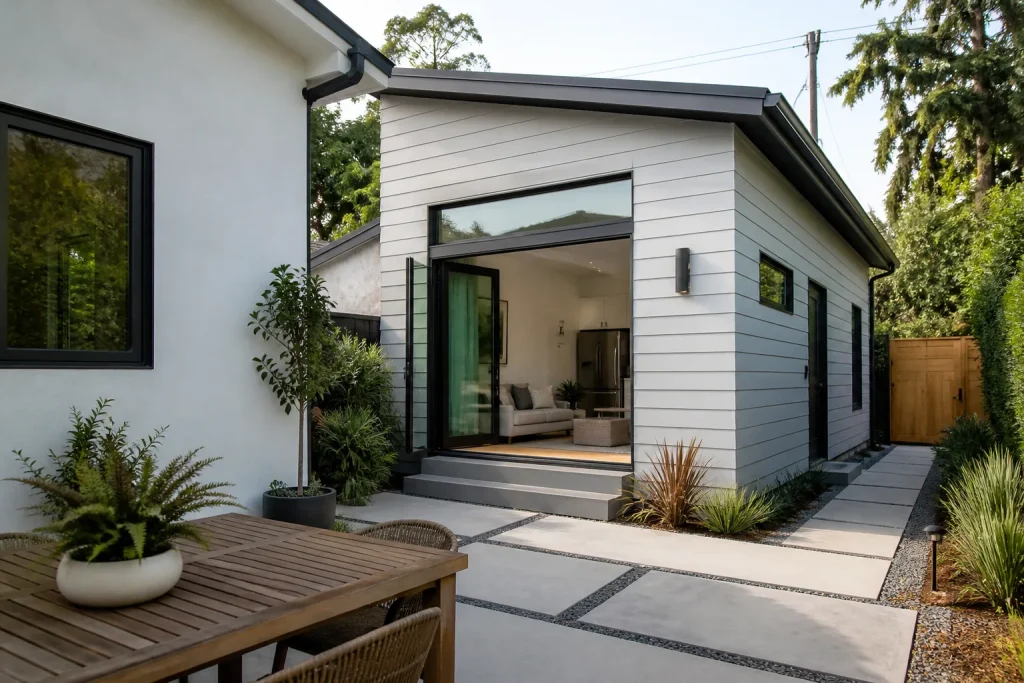
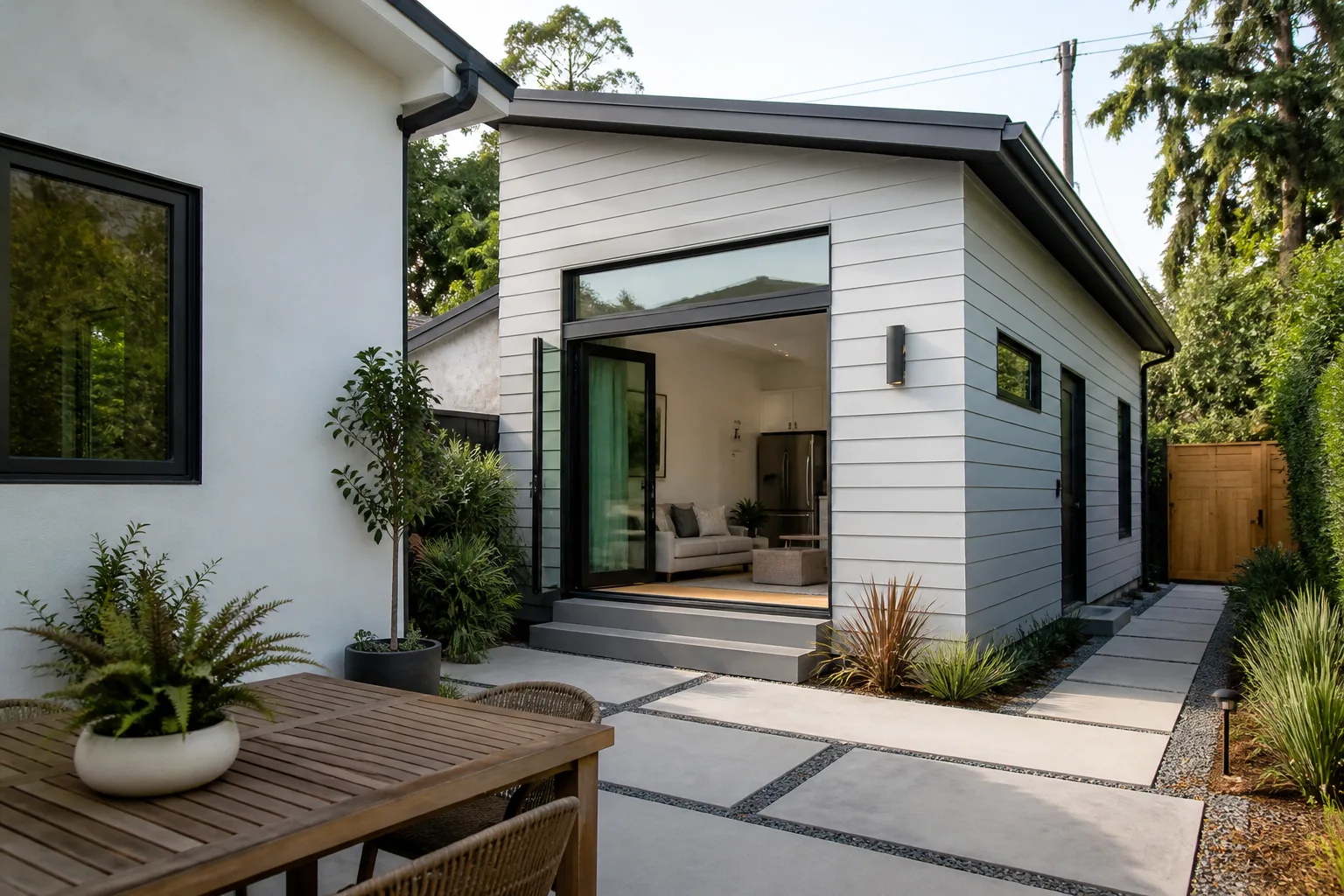
James Hardie Home Addition Contractor in Los Angeles: A Homeowner’s Guide
James Hardie fiber cement siding is one of the smartest exterior choices for a Los Angeles home addition, but here’s what most homeowners don’t realize: that impressive 30-year limited warranty can be voided by a single installation error. We’ve torn open enough botched Hardie jobs across LA to know that contractor selection matters more than the product itself. If you’re planning an addition and want it sheathed right, call (472) 248-8213 for a free estimate from a crew that installs to spec every time.
Why James Hardie Makes Sense for Los Angeles Additions
Los Angeles presents a specific set of exterior challenges: intense UV exposure, seasonal Santa Ana winds, and increasingly serious wildfire risk. James Hardie fiber cement siding handles all three better than vinyl or wood. The product is non-combustible, which matters in a city where fire hazard severity zones now cover significant portions of the San Fernando Valley, the Hollywood Hills, and the foothill communities along the 210 corridor.
Unlike wood siding that warps in dry heat or vinyl that fades under relentless sun, HardiePlank holds its shape and color. Hardie’s factory-applied ColorPlus finish is baked on, not sprayed, and it resists the kind of fading we see on homes in Sherman Oaks and Encino after just a few summers.
But the material is only half the equation. The installation is where things go sideways fast. That’s why homeowners adding square footage in Los Angeles need to think as carefully about who installs the siding as they do about which siding they choose.
What “HardieZone” Means for Your LA Addition
James Hardie divides North America into climate zones to match products to conditions. Los Angeles falls in HardieZone HZ10, which covers hot, dry, fire-prone regions. Products rated for HZ10 are engineered for UV resistance, thermal expansion, and low-moisture environments.
Here’s the problem we see repeatedly: some contractors install HZ5-rated products because they bought leftover inventory or simply didn’t check. HZ5 products are designed for colder, wetter climates with freeze-thaw cycles. Using them on a Los Angeles addition means the product isn’t engineered for our heat and sun. The warranty implications are real, and the performance difference shows up within a few years as premature fading or joint separation.
The right products for Los Angeles:
- HardiePlank Lap Siding in HZ10 rating
- HardiePanel Vertical Siding in HZ10 rating
- HardieTrim Boards in HZ10 rating
- HardieSoffit Panels for eave and overhang applications
Before you sign any contract, ask the contractor to confirm the specific product’s HardieZone rating in writing. If they can’t tell you, that’s your first warning sign.
The Four Installation Errors That Void the Hardie Warranty
James Hardie publishes precise installation specifications covering clearances, fasteners, flashing, and joint treatment. Independent field audits suggest a meaningful percentage of residential installations have at least one spec deviation. These are the four we find most often on Los Angeles projects:
- Insufficient bottom clearance from grade. Hardie requires a minimum 6-inch clearance between siding and the ground or any hardscape. In Los Angeles, where lot grading is often tight and additions are tucked against patios or walkways, installers frequently fudge this. Water wicks up, and the warranty dies.
- Improper flashing at window and door openings. Hardie is not waterproof. It’s a rain screen layer that requires correct flashing and a water-resistive barrier behind it. When flashing is skipped or done wrong, moisture gets behind the siding and attacks the framing. On a new addition, that framing is everything.
- Wrong fastener type. Hardie requires either corrosion-resistant roofing nails or specific screws. We’ve seen jobs where drywall screws or standard framing nails were used because they were already in the truck. Galvanic corrosion sets in, fasteners fail, and the siding pulls away.
- Unpainted cut edges. Every field-cut edge must be primed and painted. When installers skip this step, moisture enters the fiber cement at the raw edge and starts delamination that spreads outward. It’s invisible for years, then suddenly visible everywhere.
This is not a hypothetical risk. The warranty language is clear: installation must meet every published specification. One deviation, and your claim gets denied.
Why Hardie on an Addition Is Trickier Than on a Full New Build
Installing Hardie on an existing home is relatively straightforward: the house is already there, the envelope is established, and you’re essentially re-skinning. An addition changes everything.
The critical weak point is the transition joint where new construction meets existing wall. This seam has to accommodate differential settling between the old foundation and the new one, which is a real phenomenon in Los Angeles given our expansive clay soils in places like Valley Village and Studio City. It also has to maintain a continuous drainage plane across two different wall assemblies.
On additions we’ve inspected around Los Angeles, this joint is where moisture intrusion almost always starts. The new addition settles slightly. The existing structure doesn’t. The gap opens, water finds it, and a few years later you’re dealing with mold behind the siding.
The fix requires careful flashing design, often involving a two-part transition that allows movement while shedding water. It’s not complicated, but it has to be planned before the siding goes on, not improvised during installation.
When we build additions in Los Angeles, we treat this joint as a critical design element, not an afterthought. Our crews establish the drainage plane and flashing sequence before the first piece of Hardie goes up.
The Wildfire Context: What Hardie Means for LA Permits and Insurance
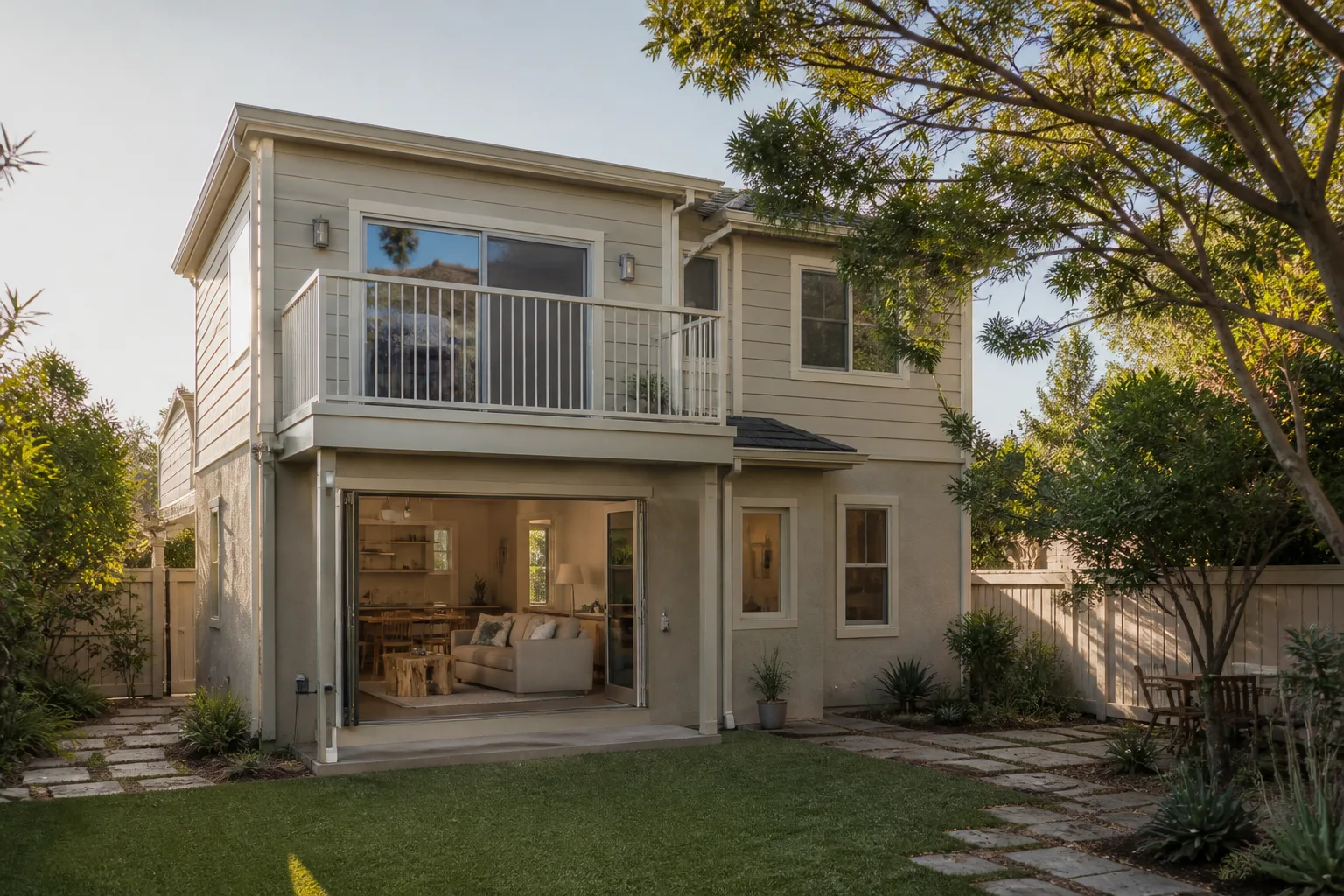
California’s building code includes Chapter 7A requirements for construction in Wildland-Urban Interface (WUI) zones, which cover a substantial portion of Los Angeles County. Fiber cement siding is explicitly listed as a non-combustible exterior wall covering that meets ignition-resistant construction standards.
That matters in two practical ways for your addition project:
First, permit approval. If your Los Angeles property falls within a high fire hazard severity zone, the building department will require ignition-resistant materials. Hardie satisfies that requirement. Wood siding does not, at least not without expensive treatments and additional documentation.
Second, homeowners insurance. We’re seeing carriers in the LA market refuse to write new policies on homes with combustible exterior cladding, or write them at premiums that make wood siding cost-prohibitive. Hardie fiber cement doesn’t just clear the insurance hurdle, it can actually help your insurability. Talk to your broker before you commit to any exterior material on an addition in a brush-adjacent area like Tarzana or the hills above Glendale.
Sutton ADU Builders has worked with James Hardie systems on additions throughout Los Angeles, and we’ve seen the permitting and insurance conversations go much smoother when the exterior is non-combustible from the start.
How to Verify a Contractor’s Hardie Installation Competency
James Hardie operates the Hardie Contractor Alliance, a certification program for contractors who complete Hardie’s installation training and commit to spec-compliant work. It’s the single most useful credential to ask about for a Hardie addition project.
Here’s what to ask any contractor before hiring them for a Hardie installation in Los Angeles:
- “Are you a member of the Hardie Contractor Alliance?” If yes, ask to see the certification. It’s verifiable through Hardie’s contractor locator.
- “Do you install to Hardie’s published specifications, or to your crew’s standard practice?” The correct answer is published specs, every time, no exceptions.
- “How do you handle the transition joint between existing structure and the new addition?” If they can’t describe a flashing strategy in detail, keep looking.
- “Will you pull permits for the addition, including the exterior cladding?” The answer must be yes. Unpermitted siding work in Los Angeles creates liability and resale problems.
- “What’s your process for documenting install compliance?” Good contractors photograph flashing before siding covers it. We do this on every project because it proves the work if a warranty claim ever comes up.
One more thing: never accept a verbal assurance that “we know Hardie.” Get it in writing that the installation will meet all current Hardie published specifications, or the contractor is responsible for correction at their cost.
When to Call a Pro
If you’re sitting in Los Angeles with an addition planned and you’re now wondering whether the siding part is something you can handle yourself, here’s our honest take. This is not a DIY weekend project. The material is heavy, the fastening details are exact, and the warranty depends on everything being right, including things you can’t see after the job is done. Fiber cement also creates silica dust when cut, which requires proper respiratory protection and tooling.
A real expert will tell you the same thing. The risk of getting it wrong is a voided warranty, a failed moisture barrier, and a five-figure repair down the line. In our experience, the cost of doing it right the first time is always cheaper than doing it over.
Related services in Los Angeles: Home Addition Contractor in Los Angeles | ADU Builders in Los Angeles | Room Addition Contractor in Los Angeles
Key Takeaways
- James Hardie fiber cement is an excellent exterior choice for Los Angeles additions, especially in high fire hazard zones where non-combustible cladding eases permits and insurance.
- Los Angeles is HardieZone HZ10. Confirm every product your contractor installs carries the HZ10 rating.
- The four most common warranty-voiding installation errors are: insufficient bottom clearance, improper flashing, wrong fasteners, and unpainted cut edges.
- The addition-to-existing-wall transition joint is the highest-risk moisture point on any Los Angeles addition. It must be flashed as a designed detail, not improvised.
- Ask for Hardie Contractor Alliance certification and documented install compliance. Verbal assurances aren’t worth the paper they’re not printed on.
The Bottom Line
James Hardie siding is a smart investment for a Los Angeles home addition, but only if it’s installed to the letter of Hardie’s published specifications. The product’s 30-year warranty is a genuine asset, and it’s exactly as strong as the crew that puts it up. Choose a contractor who can prove Hardie competency, who documents the work as it goes in, and who gives you a written price before the first tool is lifted.
If you’re in Los Angeles and need help with a Hardie-clad addition or any home addition project, Sutton ADU Builders offers free estimates. Call (472) 248-8213 and we’ll come out, take a look at your lot, and give you a straight answer about what the work should cost. Written, line-item, no surprises. That’s how we’ve done it since 2006, and it’s how the Sutton ADU Builders home team operates on every single project.
Frequently Asked Questions
For a typical 400 – 600 square foot addition in Los Angeles, HardiePlank lap siding with factory ColorPlus finish runs roughly $9 – $14 per square foot installed, so budget $8,000 – $16,000 for siding on an addition of that size depending on complexity, detailing, and whether the transition joint to the existing home needs significant flashing work. Call (472) 248-8213 for an exact quote, estimates are free.
James Hardie itself doesn’t trigger special permitting, but the addition it’s attached to does, and exterior cladding is reviewed as part of that permit package. In high fire hazard severity zones, the building department will specifically check that exterior materials meet ignition-resistant standards, which Hardie does. We pull permits on every addition we build in Los Angeles and pass final inspection before we consider the job done.
For a typical Los Angeles addition, Hardie siding installation takes 1 – 2 weeks once framing and weatherproofing are complete. The transition joint detailing, flashing, and painting of cut edges add time compared to a straightforward new-construction install. Rush jobs are where specs get skipped, so we’d rather take the full week and get it right.
Yes, Hardie offers a broad palette of ColorPlus factory finishes, and most Los Angeles homes built or re-sided in the last 15 years used a standard Hardie color. If your existing siding is faded from LA sun, there may be a slight tone difference between old and new, which is worth anticipating before you plan the addition. We’ll bring color samples to your site during the estimate.
Written by Miles Hartwell, Owner at Sutton ADU Builders, serving Los Angeles since 2006.
Need ADU Help?
Call Sutton ADU Builders - licensed & insured, here with fast after-hours help in Los Angeles.
(472) 248-8213