Last updated October 9, 2026
DIY vs Professional ADU: The Los Angeles Homeowner’s Decision Guide
California is one of the few states that lets a homeowner pull their own construction permits without a contractor’s license. It sounds like a loophole big enough to drive an excavator through. But most Los Angeles homeowners never learn the catch: Civil Code 1102 requires owner-builders to disclose that status when they sell. That single disclosure has killed sales, dropped appraisals, and left sellers holding a property they couldn’t refinance. This guide gives you the straight math on DIY versus professional ADU construction in Los Angeles, including the parts nobody puts in the brochure.
Quick Answer
For most Los Angeles homeowners, hiring a licensed professional for an ADU is the financially safer choice, not the more expensive one. DIY can work for finish work like painting or flooring, but California’s owner-builder disclosure law creates resale liability that wipes out most of the upfront savings. Licensed trades are legally required for electrical, plumbing, HVAC, and structural work regardless of how you pull the permit.
Table of Contents
- What California’s Owner-Builder Law Actually Allows
- Civil Code 1102: The Disclosure That Follows You to Closing
- Where Licensed Trades Are Legally Required
- The Real DIY Savings Calculation
- Where Partial DIY Makes Sense
- What Lenders and Appraisers Ask About an ADU
- How the Los Angeles ADU Market Rewards Paper Trails
- Common Mistakes to Avoid
- When to Call a Professional
- Frequently Asked Questions
- The Bottom Line
What California’s Owner-Builder Law Actually Allows
California Health and Safety Code Section 50662 and Business and Professions Code Section 7044 allow a property owner to act as their own general contractor on a residential project, including an ADU, if the property is their primary residence and they intend to occupy it after construction. In Los Angeles, that means a homeowner can pull building permits from the Los Angeles Department of Building and Safety (LADBS) under owner-builder status. No contractor’s license, no license board oversight.
But the law has teeth, and most people don’t read past the first paragraph. An owner-builder in California takes on the same legal duties a licensed contractor carries: worker safety compliance, workers’ compensation insurance if anyone is hurt on site, code compliance, and corrections on failed inspections. If an unlicensed helper falls off a ladder on your Los Angeles property, the owner-builder is the employer in the eyes of the state. The claim goes against your homeowners insurance, not a contractor’s general liability policy.
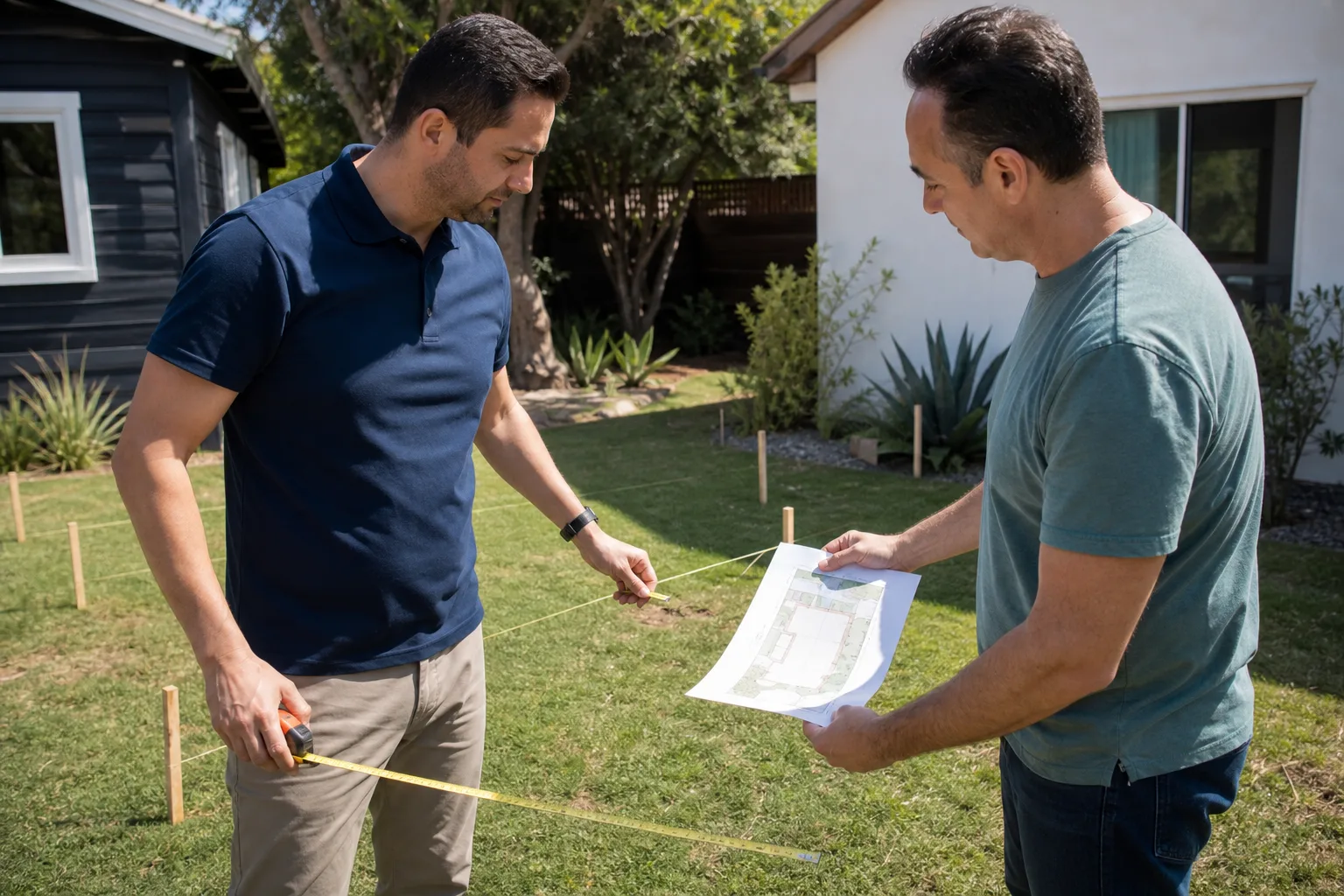
There’s also a practical limit most people discover during their first LADBS visit: the department’s plan check process doesn’t give owner-builders a shortcut. You still need full architectural and structural drawings, Title 24 energy compliance documentation, and a list of subcontractors for the trades LADBS won’t let you self-perform. In our experience, the average Los Angeles owner-builder spends 6 to 10 weeks navigating plan check before a shovel touches dirt.
Civil Code 1102: The Disclosure That Follows You to Closing
This is the part competitors don’t write about. California Civil Code 1102, the statutory real estate transfer disclosure law, requires sellers to complete a Real Estate Transfer Disclosure Statement (TDS) that includes a specific question: was any construction on the property performed by an owner-builder? If you used owner-builder permits for your ADU, you must check yes.
That yes does more than sit in a file. It tells the buyer, the buyer’s agent, the lender, and the title company that no licensed contractor was accountable for the structure’s electrical, plumbing, or foundation work. Fannie Mae and Freddie Mac underwriting guidelines treat owner-builder work as a risk factor. We’ve watched buyers’ agents in Los Angeles use that disclosure as leverage to demand $15,000 to $40,000 in price reductions for “unverified construction.” Some sales fall apart entirely.
The disclosure doesn’t expire. If you sell five years later, you disclose. If you sell twelve years later, you disclose. A licensed contractor’s paper trail – permits pulled under a contractor’s license, inspection sign-offs in the contractor’s name, a warranty from a company that still exists – answers those buyer questions before they become objections.
Where Licensed Trades Are Legally Required
Owner-builder status does not override trade licensing laws. In Los Angeles, electrical, plumbing, HVAC, and structural work must be performed by California-licensed tradespeople (C-10 electrical, C-36 plumbing, C-20 HVAC, and A or B general engineering for structural). An owner-builder cannot legally self-perform an electrical panel upgrade on an ADU, run gas lines for a tankless water heater, or pour a foundation without a licensed contractor signing off.
What happens if the work is done anyway? Three things, in this order:
- Insurance denial. If a fire or flood originates from unpermitted or unlicensed electrical or plumbing work, your homeowners insurer can deny the claim. Most Los Angeles policies have broad exclusions for unpermitted work.
- Inspection failure. LADBS inspectors check for licensed trade permits on any work they inspect. If the work was done by an unlicensed person, the inspector can issue a stop-work order and require correction by a licensed contractor at full cost.
- Resale disclosure blowback. Per Civil Code 1102, you now have to disclose not just owner-builder status but work done outside legal licensing requirements. That is a harder conversation than the standard owner-builder disclosure.
The math is simple: the trades you can’t legally do yourself are also the trades where mistakes are most expensive. A foundation correction in Los Angeles soil – much of which is expansive clay – can run $30,000 to $60,000. The plumbing rough-in for a full-bath ADU is typically $8,000 to $15,000 of the project. Those are the worst places to learn as you go.
The Real DIY Savings Calculation
The headline number sounds great: acting as your own general contractor might save 15 to 20 percent of the project cost. On a $250,000 ADU, that’s $37,500 to $50,000. But that number assumes you value your time at zero and nothing goes wrong. In Los Angeles, both assumptions are usually false.
Here’s a realistic self-performed project cost breakdown for a 600-square-foot detached ADU in Los Angeles, excluding structural and systems trades you must hire out anyway:
- Permit and plan check fees (LADBS): $5,000 to $9,000, depending on valuation and school district fees
- Architectural and structural drawings: $8,000 to $15,000 for custom, $3,000 to $6,000 for semi-stock plans
- Title 24 energy compliance and calculations: $800 to $1,500
- Required licensed trades you’ll hire regardless: $60,000 to $110,000 (electrical, plumbing, HVAC, foundation, framing inspections)
- Tools and equipment rental for finish work: $2,000 to $5,000
- Mistakes and re-dos (industry average is 5-10 percent of DIY scope): $3,000 to $8,000
- Your time, 6-12 months of nights and weekends: variable, but rarely under 400 hours
Run the numbers at 400 hours. If your time is worth $50 an hour, that’s $20,000 of labor you’re donating to the project. If you’re a working Los Angeles homeowner with kids, the opportunity cost is higher: missed weekends, a construction zone in your yard for a full year, and the mental load of managing subs you’ve never vetted. The ADU Builders in Los Angeles who do this daily carry the scheduling, the liability, and the inspection headaches as part of their price.
Where Partial DIY Makes Sense
The smart version of DIY is surgical. Some finish work doesn’t affect structural or systems permits, doesn’t shorten the life of the building envelope, and doesn’t put you in front of an LADBS inspector with a clipboard. Those are the places to roll up your sleeves.
Here’s what partial DIY looks like on a real Los Angeles ADU project:
- Painting interior walls and trim. $1,500 to $3,000 saved, zero permit implications, one weekend per room.
- Flooring installation (floating LVP or engineered wood). $2,000 to $5,000 saved, no licensed trade requirement for floating systems, and Los Angeles suppliers like Floor & Decor and Lumber Liquidators have stock on hand.
- Landscaping and irrigation around the new structure. $1,500 to $4,000 saved, but keep drainage sloping away from the foundation.
- Cabinet assembly and installation for non-load-bearing kitchen or bath runs. $1,000 to $2,500 saved, provided you’re not moving plumbing or electrical.
- Interior trim, baseboards, and door hardware. $800 to $1,500 saved, low risk, high satisfaction.
One rule for partial DIY in Los Angeles: if the task touches water, electricity, gas, or structure, hire the licensed trade. Everything else is fair game with good measurements and a little patience.
What Lenders and Appraisers Ask About an ADU
When you refinance or sell, the ADU’s construction history goes under a microscope. Lenders in the Los Angeles market have seen too many garage conversions with unpermitted wiring and too many “bonus rooms” that don’t appear on title. Their questions are predictable, and a licensed contractor’s paper trail answers every one.
- “Was the ADU built with permits?” A contractor-pulled permit set with final inspection sign-offs answers this with documentation. Owner-builder permits answer it too, but trigger question two.
- “Who performed the electrical, plumbing, and structural work?” A licensed contractor’s records show licensed subs, their license numbers, and their insurance. An owner-builder has to explain who did what, and whether it was legal.
- “Is there a warranty on the work?” Licensed contractors in California are required to stand behind their work for at least one year. Owner-builders have no such requirement because they performed the work for themselves.
- “Will the ADU appraise as living square footage?” Appraisers in Los Angeles county will only credit ADU square footage that is permitted, habitable, and has certificate of occupancy. Unpermitted or self-permitted work with open inspections doesn’t count.
The difference between those two conversation paths is the difference between a smooth closing and a renegotiation. We’ve seen refinance applications delayed six to eight weeks while owners track down permit records and write correction letters for work their “contractor” (actually a handyman) did without pulling trade permits. The Home Addition Contractor in Los Angeles who pulled clean permits from day one doesn’t leave you in that position.
How the Los Angeles ADU Market Rewards Paper Trails
Los Angeles has built more ADUs than any city in California since the state loosened ADU laws. That means two things for sellers. First, buyers have options. Second, buyers have learned what to ask. A permitted ADU with licensed-contractor paperwork sells faster and higher than an owner-builder project with a disclosure checkmark.
Appraisers for FHA and VA loans in Los Angeles are now specifically trained to look for unpermitted additions and ADU construction quality. A licensed contractor’s work meets one more threshold that matters: lender confidence that the ADU won’t become a liability. Some local buyers are explicitly requesting ADUs with prefab brand documentation – a Dvele or Plant Prefab ADU with a manufacturer’s warranty and installer paperwork reads differently than a backyard structure with unknown provenance.
One more Los Angeles-specific factor: the city’s ADU inspector pool is stretched. Plan reviews that took 4 weeks before 2020 now routinely take 8 to 12. Contractors with long-standing relationships at LADBS and a history of passing inspections on first visit keep projects moving. An owner-builder navigating that same queue solo spends more calendar time in limbo, and every month of limbo is a month the ADU isn’t generating rent.
Common Mistakes to Avoid
- Pulling an owner-builder permit for electrical work. It’s not allowed under California trade licensing law, and the LADBS inspector will catch it. You’ll pay a licensed electrician to redo it, at full market rate.
- Assuming owner-builder disclosure “won’t be a big deal at sale.” In the Los Angeles market, buyer’s agents use that disclosure as a negotiation lever. We’ve watched it cost sellers $15,000 or more at the closing table.
- Under-budgeting for Los Angeles soil conditions. Expansive clay soil in neighborhoods like Baldwin Hills and parts of the Valley requires foundation engineering that stock ADU plans don’t include. That’s a $10,000 to $20,000 correction if it’s discovered mid-project.
- Skipping Title 24 energy compliance. LADBS won’t issue a final certificate of occupancy without it. Backfilling a Title 24 report after framing is more expensive than doing it during design.
- Hiring a handyman for tasks that require a license. The labor savings vanish the first time an inspector stops the job or a buyer’s lender requests trade license numbers.
- Starting before the permit is issued. LADBS issues stop-work orders. Unpermitted work gets flagged in the permit record, and that flag follows the property in Los Angeles county databases.
When to Call a Professional
If your ADU touches foundation, electrical panel, plumbing rough-in, HVAC, or structural framing, call a licensed professional. If you plan to sell or refinance within five years, call a licensed professional. If you’re not prepared to personally manage subcontractors for six to twelve months, call a licensed professional. The Room Addition Contractor in Los Angeles you hire should give you a written price before work begins and a named warranty in writing. Sutton ADU Builders offers free estimates in Los Angeles – call (472) 248-8213 and we’ll walk the property, talk through your options, and hand you a written number before anything else.
Frequently Asked Questions
Yes, California owner-builder law allows a homeowner to act as their own general contractor on an ADU if the property is their primary residence and they intend to occupy it. But electrical, plumbing, HVAC, and structural work must still be performed by licensed tradespeople, and the owner-builder status must be disclosed at resale under Civil Code 1102.
No. Electrical work requires a California C-10 electrical license, full stop. Owner-builder status doesn’t override trade licensing requirements, and unlicensed electrical work is a basis for insurance claim denial and inspection failure.
You might save 15 to 20 percent on the project cost before accounting for your own time, tool costs, mistakes, and the resale discount that often accompanies owner-builder disclosure. For most Los Angeles homeowners, the net savings is close to zero once those factors are added in. Call (472) 248-8213 for an exact quote on your project – estimates are free.
The lender will ask whether the ADU was permitted, who performed the electrical, plumbing, and structural work, whether a warranty exists, and whether the square footage counts as habitable. A licensed contractor’s paper trail answers all four. Owner-builder permits leave those questions open.
The biggest hidden cost is resale liability from Civil Code 1102 owner-builder disclosure. A buyer’s agent can use that disclosure to negotiate a price reduction or kill the deal entirely. In the Los Angeles market, that liability typically costs more than the upfront GC fee.
Yes. Sutton ADU Builders has direct experience with Dvele, Plant Prefab, and Mighty Buildings product lines, plus Tuff Shed conversions and James Hardie exterior systems, so we can give you honest guidance on which product line fits your Los Angeles lot and budget. Call (472) 248-8213 to schedule a free estimate.
The Bottom Line
The DIY vs professional ADU question has a clear answer for most Los Angeles homeowners: hire the licensed contractor, keep your hands off the electrical and plumbing, and put your DIY energy into paint and landscaping. For more guides & resources on navigating ADU construction, explore our blog. California’s owner-builder law is a trap disguised as a loophole – the savings are front-loaded, but the liability sits on your deed until you sell. Los Angeles buyers and lenders have learned to read that disclosure. The smart play is a written price from a licensed builder, a paper trail that answers every lender question, and a warranty with teeth. That’s the decision that holds up five, ten, and fifteen years from now.
Written by Miles Hartwell, Owner at Sutton ADU Builders, serving Los Angeles since 2006.