Last updated October 9, 2026
How to Hire a ADU Contractor in Los Angeles: A Step-by-Step Guide
The California Contractors State License Board logged over 20,000 consumer complaints in a recent two-year period, with unlicensed activity and abandonment of contract topping the list. ADU work sits squarely in the crosshairs: it’s relatively new, it’s high-dollar, and it attracts every fly-by-night operator with a pickup truck and a business card. In Los Angeles, where ADU permits have surged past 5,000 per year and construction demand consistently outpaces supply, the gap between a legitimate contractor and a fraud is often just a low bid and a confident handshake. This guide walks you through exactly how to verify a contractor before you sign, what documents to demand, how to read a bid like an auditor, and the questions that separate a real builder from a paper contractor in Los Angeles. For more guides & resources, see our blog.
Quick Answer
To hire an ADU contractor in Los Angeles, verify their CSLB license number is active and matches the name on their paperwork, then request four documents before signing: the license, a current liability insurance certificate, a workers’ comp certificate, and a written lien waiver policy. Interview at least three references with specific questions about who actually showed up and whether the final price matched the written bid, and reject any bid with vague line items, uncapped allowances, or a payment schedule that takes more than 10% before work begins.
Table of Contents
- Step 1: Verify the CSLB License Before You Talk Money
- Step 2: The Four Documents to Request Before Signing Anything
- Step 3: How to Read a Los Angeles ADU Bid for Red Flags
- Step 4: Why Knowing the Name and Photo of Every Person on Your Property Is a Safety Baseline
- Step 5: The Exact Questions to Ask Three References
- Step 6: Prefab vs. Site-Built in Los Angeles: A Practical Comparison
- Step 7: Permits, Setbacks, and Los Angeles Code Requirements
- Common Mistakes to Avoid
- When to Call a Professional
- Frequently Asked Questions
- The Bottom Line
Step 1: Verify the CSLB License Before You Talk Money
Every legitimate ADU contractor in Los Angeles carries a California Contractors State License Board license. A general building contractor holds a Class B license. Some ADU specialists also carry a Class A (engineering) or Class C specialty license depending on the scope. The license number should appear on every document the contractor hands you: the bid, the business card, the truck door, the website footer. If it’s missing from any of these, treat that as a flag.
Here’s the part most guides skip: “active” status is not the only thing to check. The CSLB database at cslb.ca.gov shows current license status, issue date, expiration date, and any disciplinary actions or complaints on file. A license can be “active” while the contractor has an open complaint or a suspended workers’ comp exemption. You want to see:
- The license status says “Active” and not “Expired,” “Suspended,” or “Revoked.” This sounds obvious. It isn’t. Contractors in Los Angeles routinely let licenses lapse mid-project and keep working.
- The name on the license matches the name on the contract. If the license belongs to “J. Martinez Construction Inc.” but your contract says “SoCal ADU Solutions,” ask who is actually signing. Subcontractor relationships are fine, but the entity you sign with must be the licensed entity.
- The license classification covers ADU work. A C-15 flooring contractor cannot legally sign a contract for a full detached ADU. The CSLB database lists the classification right next to the license number.
- Workers’ compensation status is not listed as “Exempt” without explanation. Any contractor with employees must carry workers’ comp. An exempt status means zero employees, which for a full ADU build is structurally improbable.
If a contractor gives you a license number that doesn’t pull up, or pulls up under a different name, stop the conversation. In our experience in Los Angeles, the most common scam is a “borrowed” license: a salesperson hands you a number belonging to a legitimate contractor they have no actual relationship with. You sign, pay a deposit, and the real license holder has never heard of you.
Los Angeles homeowners have one extra layer of protection here: ADU Builders in Los Angeles are subject to the city’s own permitting and inspection process, which creates a public record of every permitted project. If a contractor claims ADU experience but has pulled zero permits in the city, that claim is unverifiable. Ask for the addresses of two past ADU projects in Los Angeles and check the Department of Building and Safety permit portal. If the permits don’t exist, neither does the experience.
Step 2: The Four Documents to Request Before Signing Anything
A bid is not a contract. A contract is not evidence of insurance. And insurance is not evidence of anything unless you have the actual certificate in your hand, naming you as the property owner. Before you sign any ADU agreement in Los Angeles, require these four documents:
- CSLB license printout. Not the number written on a bid. The actual printout or a live link to the license’s CSLB page showing status, classification, issue date, and any complaints. This takes two minutes to pull and costs nothing.
- Certificate of liability insurance. Ask for a current ACORD 25 certificate naming you, the homeowner, as an additional insured. Check the policy dates. Check that the policy limit is at least $1 million. Call the insurance carrier directly to verify the certificate is authentic. Fake certificates are a known problem in Los Angeles construction.
- Workers’ compensation certificate. If the contractor has employees or subcontractors, they need workers’ comp. If a worker is injured on your property and the contractor doesn’t carry workers’ comp, the injured worker can file a claim against your homeowners insurance. This is not a theoretical risk. It happens in Los Angeles every month.
- Written lien waiver policy. A lien waiver is a document signed by every supplier and subcontractor saying they’ve been paid for work completed to date and waives their right to file a mechanics lien against your property. You want the contractor to explain, in writing, when they will provide lien waivers (typically with each draw payment) and what format they use (conditional or unconditional). If the contractor stumbles on this question, you’re talking to someone who doesn’t manage the financial back end of their projects.
At Sutton ADU Builders, every project follows the Threshold Standard: a written price before any work begins, a 365-day written workmanship guarantee, and a free second visit if any element of the build fails. That’s a named, written promise, not a verbal assurance. If a contractor can’t put their guarantees in writing before you sign, walk.
Step 3: How to Read a Los Angeles ADU Bid for Red Flags
ADU bids in Los Angeles typically range from a two-page summary to a 20-page line-item breakdown. The length matters less than the specificity. A detailed bid tells you what you’re buying. A vague bid tells you what you’re about to argue about.
Here’s what a healthy ADU bid includes:
- Line items for every major trade: foundation, framing, roofing, electrical, plumbing, HVAC, drywall, insulation, paint, flooring, windows, doors. If a bid says “site work” without breaking out grading, utility trenching, and foundation work separately, you’re looking at a placeholder number.
- Specific brand names and model numbers for major systems: not “water heater” but “Rheem 40-gallon natural gas water heater, model XG40T06EC36U1.” Los Angeles homeowners installing prefab ADUs often see bids referencing specific factory models. That’s good. It means the contractor has actually priced the unit, not guessed at it.
- Allowances with caps. Allowances for fixtures, flooring, or appliances are normal. But every allowance must have a dollar cap and a written statement of what happens if the homeowner exceeds it. “Allowance: $8,000 for kitchen fixtures” is fine. “Allowance: TBD” is not.
- A defined payment schedule tied to milestones, not dates. The schedule should follow the work: 10% at contract signing, then draws at foundation completion, framing completion, drywall, and final inspection. Never more than 10% before any work begins. California law caps the down payment at $1,000 for home improvement contracts, but ADU projects often legitimately exceed this cap through progress draws. The red flag is a 30% or 40% initial deposit. Contractors who front-load cash are either undercapitalized (and will run out of money mid-project) or planning to disappear.
In Los Angeles specifically, watch for bids that exclude utility connection fees. LADWP and SoCalGas charges for new service connections, gas line extensions, and electrical service upgrades can run $5,000 to $25,000 depending on your lot. Some contractors deliberately exclude these from the bid to look cheaper, then bill them as “change orders” later. A reputable contractor flags these costs upfront, even if they’re paid directly to the utility. Ask point-blank: “Does this bid include all utility connection fees?” Get the answer in writing.
Step 4: Why Knowing the Name and Photo of Every Person on Your Property Is a Safety Baseline
When you hire an ADU contractor in Los Angeles, you’re not just hiring a company. You’re granting access to your property for four to twelve months to a rotating cast of workers, subcontractors, delivery drivers, and inspectors. Most homeowners never learn the names of more than one or two of these people. That’s a security gap, not a minor inconvenience.
Ask yourself: if someone knocked on your door tomorrow and said they were with the framing crew, would you be able to verify that? If you’re home alone, or watching young kids, or recovering from surgery, that question isn’t abstract. It’s the difference between opening the door to a legitimate worker and opening it to a stranger with a clipboard.
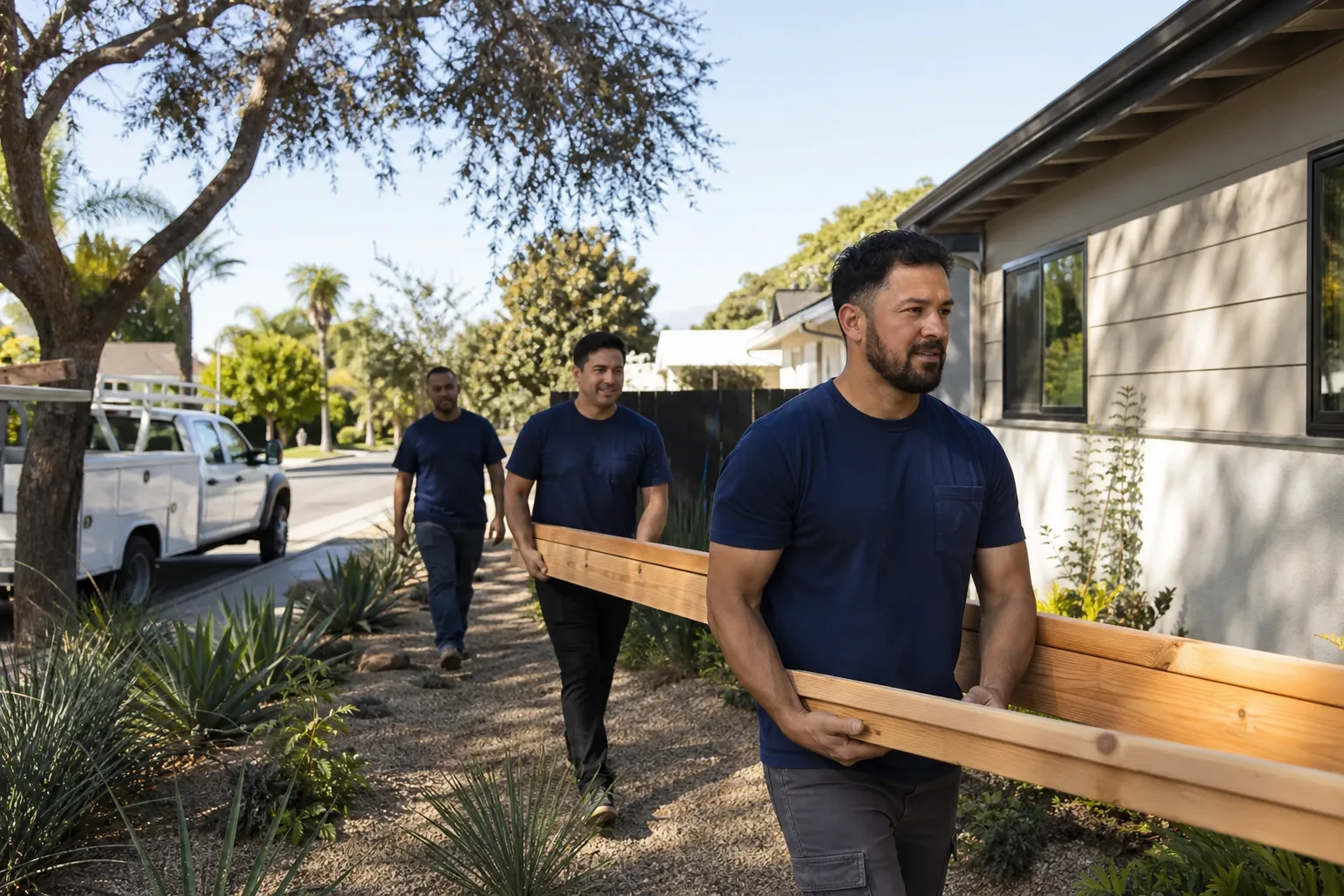
This is what the Threshold Standard addresses directly. Every Sutton ADU Builders technician is background-checked and identity-verified. Their name and photo are sent to you before they arrive. They show up in a clean, marked uniform and they show a photo ID badge at the door. Every time. Not just the project manager. Every person.
You can ask the same of any contractor. “Will you send me the name and photo of every person who will be on my property before they arrive?” is a reasonable question. The answer tells you a lot about how the company operates. A contractor who can’t or won’t do this runs a loose operation where an unvetted worker or an unlicensed subcontractor can walk onto your property with no one asking questions. That’s how tools go missing. That’s how a “plumber” turns out to be a guy who answered a Craigslist ad. That’s how a homeowner in the San Fernando Valley came home to find her jewelry gone and no record of who was in her house that day.
Identity verification is not a premium amenity. It’s the baseline for hiring anyone who will hold a key to your home. In Los Angeles, where a single ADU can involve 30 different people crossing your threshold over the course of a year, knowing who each of them is isn’t paranoia. It’s the bare minimum.
Step 5: The Exact Questions to Ask Three References
Most reference checks are theater. Homeowners call a past client, ask “Were you happy with the work?”, get a “Yes, they were great,” and feel reassured. That tells you nothing. The contractor picked that reference because they know they’ll say something nice. The question that separates a real reference from a rehearsed one is specificity.
Here are the exact questions to ask three references, and what the answers tell you:
- “Who was on the job site most days? Can you name the project manager and the lead framer or finish carpenter?” A real client can name at least one or two people. A fake or coached reference stumbles. More importantly, the answer tells you whether the contractor used a consistent crew or rotated strangers through the job.
- “What did the final price end up at compared to the original bid? Can you give me a percentage?” If the answer is “Right on budget, maybe 2-3% over” versus “About 30% over by the end,” you’re learning whether this contractor prices honestly or buys jobs with low bids.
- “What went wrong during the project, and how did the contractor handle it?” Nothing ever goes perfectly. A reference who says “Honestly, nothing went wrong” is either lying or the project was a two-week door installation, not a 10-month ADU. A reference who describes a real problem, then describes a calm, documented resolution, is gold.
- “Did the contractor pull all required permits and pass final inspection the first time?” Failed inspections happen. Repeated failed inspections suggest sloppy work or inexperience. This question also tells you whether the contractor tried to skip permits entirely.
- “Would you hire them again for a project of the same size? Why or why not?” Straightforward. But listen to the hesitation, not just the words. A two-second pause before “Yes, definitely” tells you more than the yes.
Three references, five questions each. This is a 15-minute conversation that can save you $50,000 and a year of frustration. In Los Angeles, where ADU referrals often come from friends or Facebook groups, people skip this step because the referral felt warm. Warm is not verified. Verify anyway.
Step 6: Prefab vs. Site-Built in Los Angeles: A Practical Comparison
Los Angeles is one of the few markets where prefab and modular ADUs are genuinely competitive with site-built construction. The math matters, so here it is plainly:
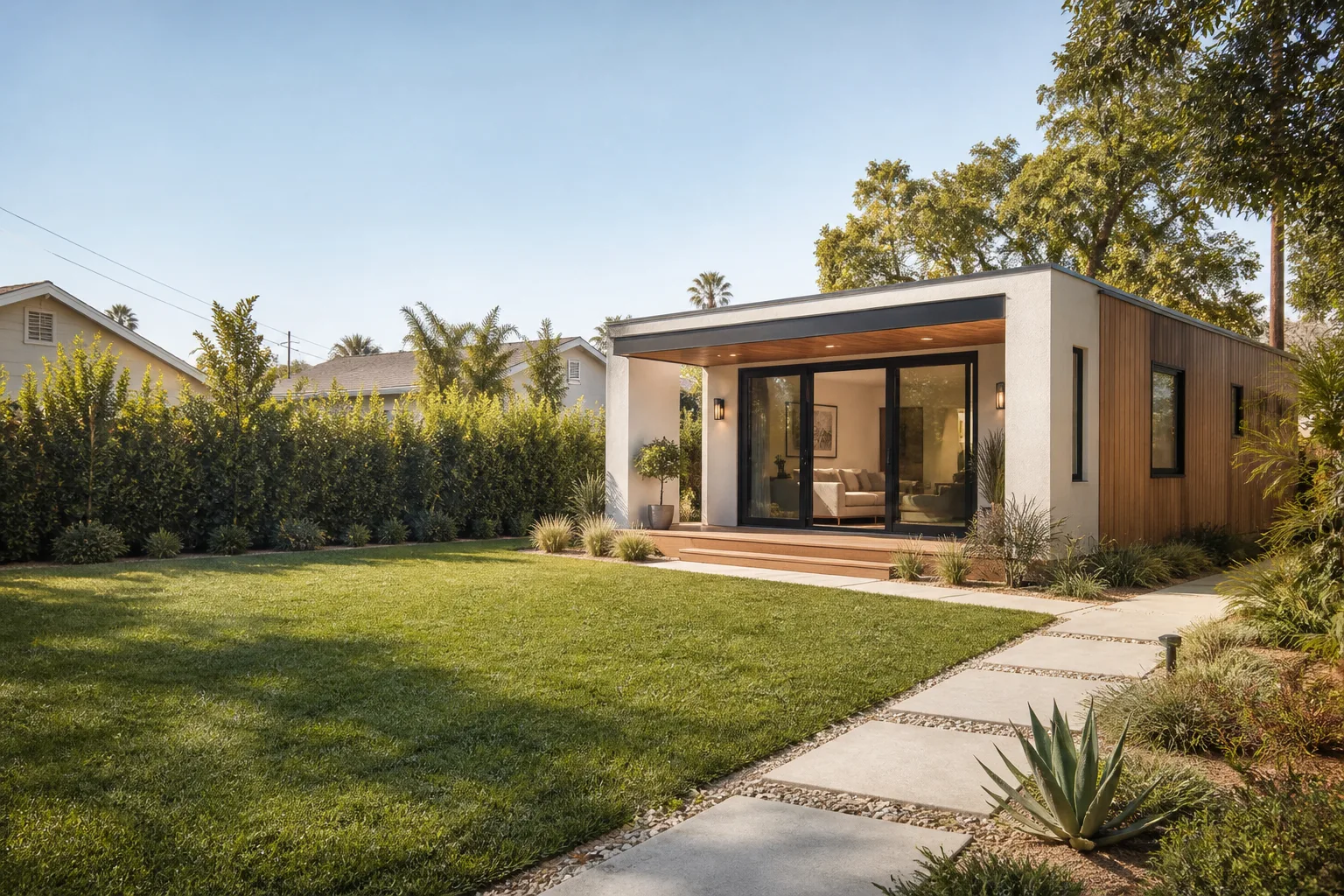
A factory-built ADU from a company like Boxabl or Plant Prefab typically arrives 60-80% complete: framing, insulation, drywall, electrical, plumbing, and fixtures already installed at the factory. On-site work is limited to foundation, utility connections, and finishing. That compresses the construction timeline from 8-12 months to 3-6 months, which for a Los Angeles homeowner renting elsewhere or housing a parent in a bedroom is a real saving.
Site-built ADUs, by contrast, give you complete flexibility on dimensions, materials, rooflines, and finishes. A custom 1,200-square-foot ADU on a hillside lot in Silver Lake or Echo Park can be built around existing trees, unusual terrain, and specific orientation requirements that a factory module can’t accommodate. You pay for that flexibility in time and, often, in cost uncertainty.
Rough Los Angeles price ranges for a 600-800 square foot one-bedroom ADU:
- Prefab/modular (Boxabl, Plant Prefab, Mighty Buildings): $180,000-$280,000 all-in, including delivery, crane, foundation, and utility connections.
- Site-built standard finish: $250,000-$380,000, depending on soil conditions, utility distances, and finish level.
- Site-built custom or difficult lot: $380,000-$500,000+, especially on hillside lots, lots requiring retaining walls, or lots with long utility runs.
A Tuff Shed conversion can be a lower-cost path for a simple back-house office or guest room, but it is not a habitable dwelling under Los Angeles building code unless it’s substantially upgraded: insulation, electrical, plumbing if you want a bathroom, egress windows, and a proper foundation. Some Tuff Shed structures can be permitted as ADUs with significant modification. Others cannot. Be realistic about what a “shed conversion” will actually pass as before you spend money.
For exterior cladding, James Hardie fiber cement is the most common premium siding specified on Los Angeles ADUs, both prefab and site-built. It holds up to the coastal fog in Santa Monica and the inland heat in the Valley, and it handles the seismic movement common to Los Angeles framing without the cracking that stucco develops over time. If your bid specifies “fiber cement,” confirm it’s James Hardie specifically. Generic fiber cement is not the same product.
Step 7: Permits, Setbacks, and Los Angeles Code Requirements
Every ADU in Los Angeles requires a building permit from the Los Angeles Department of Building and Safety (LADBS). There is no legal path to an unpermitted ADU in Los Angeles, regardless of what a contractor tells you. Unpermitted ADUs are discovered during sale inspections, refinance appraisals, or neighbor complaints, and the result is either a forced retrofit at market rates or a demolition order. Neither is worth it.
Los Angeles ADU code details worth knowing:
- Setback: the required gap between your new structure and the property line. For detached ADUs in Los Angeles, the standard rear and side setback is 4 feet. Front-yard setbacks follow the primary dwelling’s requirements. A good contractor checks your specific lot’s setback requirements during the feasibility phase, before you pay for architectural drawings.
- Height limits: detached ADUs are typically limited to 16 feet for lots with single-family homes, with specific exceptions. If your lot is in a historic overlay zone or hillside area, additional height restrictions apply.
- Utility connections: LADWP and SoCalGas charge separate fees for new connections, and some older Los Angeles neighborhoods require trenching through the street, which triggers its own permit and inspection process. This is the single most common source of surprise ADU costs in Los Angeles.
- Soil and seismic requirements: Los Angeles sits in Seismic Design Category D. ADU foundations require specific engineering details, especially on hillside lots or lots with expansive soil. A contractor who hand-waves this is either ignorant or cutting corners on engineering.
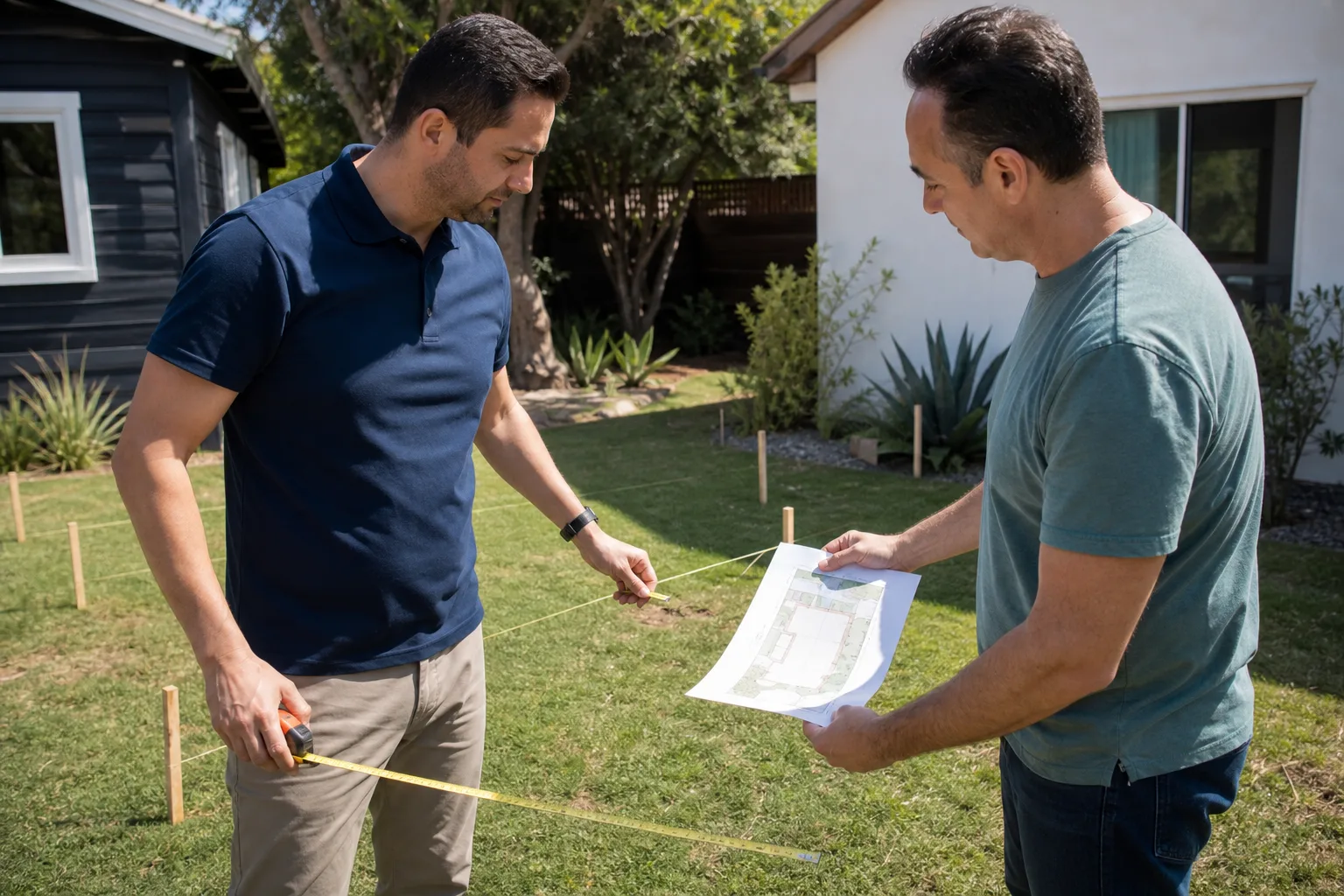
Your contractor should handle the full permit process: drawings, submittal, plan check, corrections, and inspection scheduling. Some Los Angeles homeowners hire a separate architect or drafter, then bring a contractor in for construction. That split approach can work, but it creates a gap: the architect doesn’t watch the build, and the contractor doesn’t own the design. If something doesn’t match, you’re in the middle. A design-build contractor, or a contractor who works from your architect’s drawings under a single point of accountability, is typically smoother.
Common Mistakes to Avoid
- Signing before verifying the license. In Los Angeles, an out-of-state contractor, an unlicensed “project manager,” or a contractor working under someone else’s license is common. Verify first. Sign second. No exceptions.
- Paying more than 10% before work begins. California law caps the initial deposit on home improvement contracts at $1,000. ADU projects may legally structure additional early draws, but anything beyond 10% before ground is broken is a financing problem for the contractor, not a normal practice.
- Accepting a bid with uncapped allowances. “Allowance: TBD” means “You’ll find out later.” A Los Angeles ADU with uncapped allowances typically runs 20-30% over the bid price by the time the change orders stop.
- Skipping the workers’ comp check. A worker injured on your Los Angeles property without the contractor’s workers’ comp in place becomes a claim against your homeowners insurance. Verify the certificate. Call the carrier.
- Choosing the lowest bid without auditing it. The lowest bid in Los Angeles ADU construction is often the highest final cost. It excludes utilities, uses vague language, and banks on you not reading the fine print.
- Not asking who will be on the job site. Months of construction means dozens of people on your property. If the contractor can’t tell you who they are before they arrive, you’re running an unsecured site.
- Trusting a referral without checking the paperwork. Referrals are a starting point, not a verification. In Los Angeles, even well-meaning friends have recommended unlicensed contractors who did fine work once and dissolved when the next project went wrong.
When to Call a Professional
Some parts of the ADU hiring process can be handled on your own: pulling CSLB records, calling references, asking for insurance certificates. Other parts should not be: reading engineering drawings, auditing a bid against Los Angeles code requirements, negotiating a fair payment schedule. And no part of a construction project should be handled by someone who can’t produce a license and a photo ID at your door. If you’re at the point of comparing bids and something doesn’t add up, or you’re not sure whether a Tuff Shed conversion will pass inspection as an ADU, or you want someone who has actually built ADUs in Los Angeles to walk the lot and tell you honestly what’s possible, that’s the moment to call.
Our home addition team in Los Angeles and our room addition specialists do exactly this: walk the property, review the lot constraints, and give you a written price with names attached before any tools arrive. Sutton ADU Builders offers free estimates in Los Angeles. Call (472) 248-8213 and a live person answers, 24 hours a day, 7 days a week.
Frequently Asked Questions
Most detached ADUs in Los Angeles run $180,000 to $500,000 all-in, depending on size, prefab versus site-built, lot difficulty, and finish level. A 600-800 square foot prefab unit typically lands in the $180,000-$280,000 range including delivery and utility connections; a custom site-built ADU on a standard lot typically runs $250,000-$380,000. Call (472) 248-8213 for an exact quote on your lot. Estimates are free.
Search the license number on the CSLB website at cslb.ca.gov and confirm the status says “Active,” the name on the license matches the name on your contract, and the classification covers ADU work (typically Class B). If the number doesn’t pull up or pulls up under a different name, stop the conversation and do not sign anything.
A Tuff Shed structure can be converted to an ADU in Los Angeles only if it’s substantially upgraded to meet building code: insulation, electrical, egress windows, a proper foundation, and plumbing if you want a bathroom. Some Tuff Shed shells can be permitted as ADUs with significant modification; others cannot. Get a licensed Los Angeles ADU contractor to confirm feasibility before you buy the structure.
A complete ADU bid in Los Angeles includes line items for every major trade, specific brand names for major systems, allowances with dollar caps, a milestone-based payment schedule, and explicit confirmation that utility connection fees are included. Anything less is an invitation to change orders later.
Yes. Every legal ADU in Los Angeles requires a building permit from LADBS. Unpermitted ADUs are discovered during sale inspections, refinance appraisals, or neighbor complaints, and the result is a forced retrofit or demolition. There is no legal path to an unpermitted ADU in Los Angeles.
A prefab ADU from a factory builder typically takes 3-6 months from permit approval to move-in, including foundation, delivery, and utility connections. A site-built ADU typically takes 8-12 months depending on size, lot difficulty, and inspection scheduling. If a contractor promises a 60-day site-built ADU in Los Angeles, ask for the addresses of the last two projects they completed in that timeline.
The Bottom Line
Hiring an ADU contractor in Los Angeles is an exercise in verification, not trust. Verify the license. Verify the insurance. Verify the references with specific questions. Verify who will be on your property by name and photo. Verify the bid has real line items and real caps. Verify the guarantees are written, not spoken. The contractors who pass all of these checks are rare, and they charge for their thoroughness. The contractors who fail any of them are common, and they charge for their absence later. Los Angeles has no shortage of either. Choose carefully.
Written by Miles Hartwell, Owner at Sutton ADU Builders, serving Los Angeles since 2006.