Mighty Buildings New Detached ADU: The Los Angeles Owner’s Guide
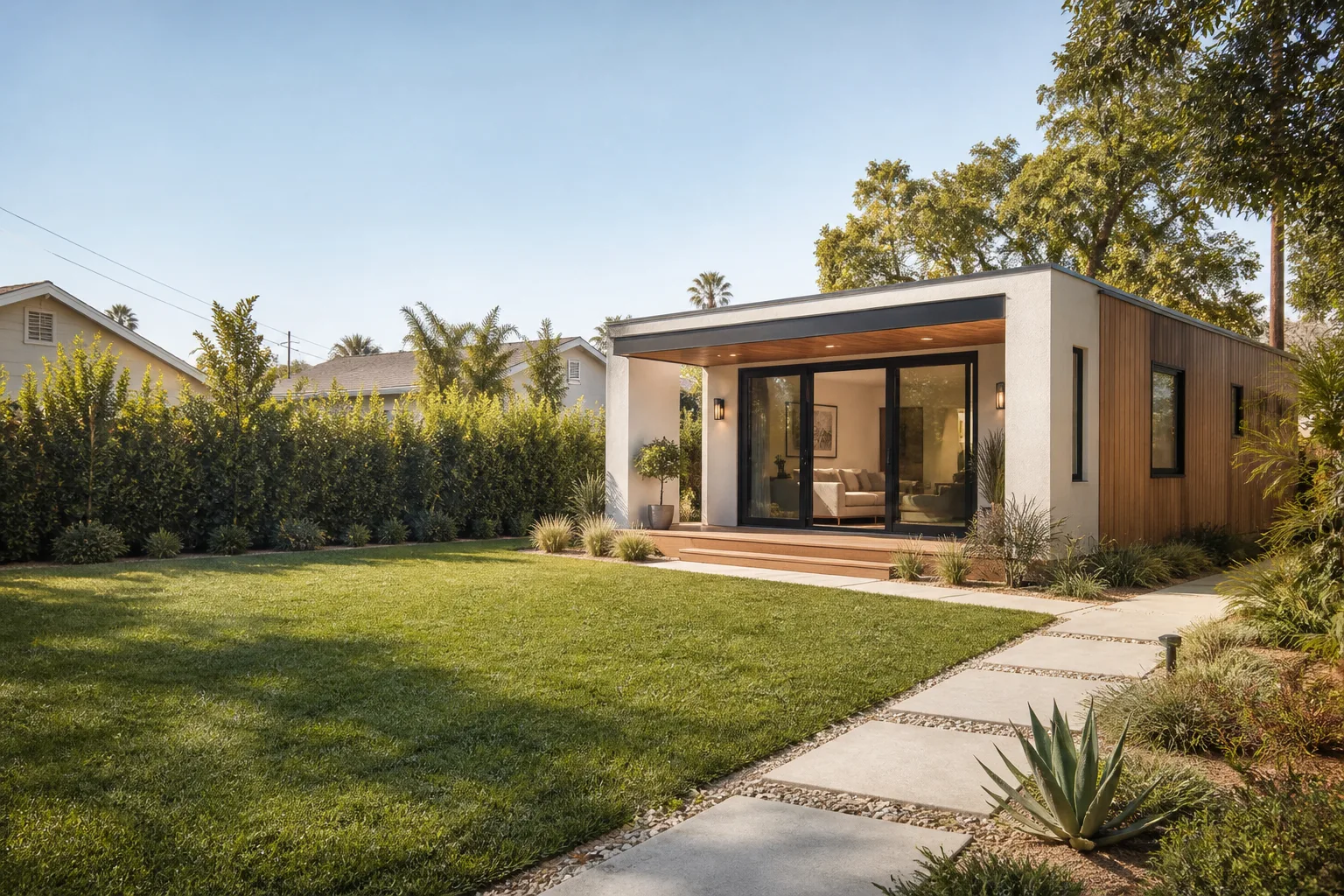
We stock and install replacement components for Mighty Buildings new detached ADUs across Los Angeles, with most panel, envelope, and mechanical swaps running $1,200 to $8,400 installed depending on the part and how much of the assembly we need to open up. Most owners discover a part has failed the same way: a door that won’t close cleanly, a wall section that feels warmer than it should on a hot afternoon, or a utility hookup that’s suddenly underperforming. The good news is that Mighty Buildings panels are modular by design, which means we can usually isolate and replace a single failing section without disturbing the rest of the structure. Sutton ADU Builders is an independent service provider, not affiliated with Mighty Buildings, but we work on these units regularly enough to know their quirks before we show up.
Which Mighty Buildings Models This Applies To
Mighty Buildings has produced several panelized ADU lines since they started delivering units in the California market, and the compatibility question is the first thing we sort out on any service call. The early Mighty Mod series and the later Mighty House models share the same composite panel system, but the connection hardware, sealant chemistry, and utility chase layouts differ between production years. The most reliable way to identify your unit is the serial plate on the interior of the mechanical closet or under the kitchen sink: the first two digits of the serial number indicate the production year, and the model code is printed next to the weight rating. What fails first on these units in Los Angeles is almost always the exterior joint sealant, followed by the door threshold assemblies and the mini-split condenser mounts. Mighty Buildings uses a proprietary fiber-reinforced polymer composite for their wall panels, and while the panels themselves hold up well, the perimeter fasteners and gaskets are the parts that need attention by year five or six, especially on lots exposed to full afternoon sun in the San Fernando Valley or the foothill canyons.
Signs Your Mighty Buildings New Detached ADU Is Failing
- Interior wall temp swings you can feel with your hand. A composite panel that’s delaminating or lost its thermal seal will feel noticeably warmer on the inside face than the panels around it, usually first visible as a vertical stripe near a window or corner. That’s a gap in the envelope, not a thermostat problem.
- Caulking that’s cracking, pulling away, or turning chalky at the seams. The UV exposure here breaks down sealants faster than the manufacturer’s generic lifespan chart suggests, and once water gets behind a seam, the panel edge starts wicking moisture. This is the most common call we get in coastal and canyon-adjacent Los Angeles neighborhoods.
- A door that suddenly needs a hard pull or won’t latch cleanly. Panelized ADUs settle, and the door frames on Mighty units are anchored to the composite wall sections, so a quarter-inch of movement shows up at the latch before it shows up anywhere else. Ignoring it usually means replacing the threshold and the door bottom sweep together.
- Higher-than-expected utility bills matched to a specific season. If your mini-split runs more in August than it did the summer before and nothing else changed, the envelope or the duct chase behind the utility wall has probably opened up a leak path. Heat gain in Los Angeles is a parts problem, not just a weather pattern.
- Condensation or faint staining at the panel joints. Any sign of moisture where two panels meet means the gasket between them has failed. Left alone, that moisture migrates into the fiber-reinforced edges and the panel becomes a replace-not-repair item within a single rainy season.
Replacement Cost & What’s Included
A single panel replacement on a Mighty Buildings ADU in Los Angeles typically runs $2,400 to $6,800 installed, including the panel, new perimeter gaskets, sealant, and the labor to unmount and reseat the section. Door threshold and sweep replacements run $600 to $1,400. Joint resealing on a full unit, which is best handled as preventive work every four to six years given our UV and marine-layer conditions, runs $1,800 to $4,200 depending on linear footage and how much prep the old sealant needs. We give you a written line-item price before any work starts, and the 365-Day Done Right Promise covers defects in workmanship for one full calendar year from project completion. Miles Hartwell has told more than one Los Angeles homeowner that a reseal now is cheaper than a panel replacement later, and the numbers back him up.
DIY or Call Us?
You can safely inspect your own unit: run your hand along the interior panel faces on a hot day, check the exterior seams with a flashlight for cracks, and look at the door threshold from inside with the door closed. What you should not do is attempt to remove a composite panel, re-tension a door frame, or work on the electrical chase behind the utility wall. The panel connections carry structural load and the utility wall is fed by live circuits, and a panel that’s been half-removed by a well-meaning homeowner creates a bigger problem than the one it was meant to solve. If you find something that looks off, call us at (472) 248-8213 and we’ll tell you over the phone whether it’s likely a service call or just normal behavior for a panelized unit in this climate. Tell me what you actually need, and I’ll tell you what it actually costs.
FAQs
Panels themselves should last 30 years or more, but the joint sealants, door thresholds, and mini-split mounts typically need attention every five to seven years in Los Angeles because our UV index and coastal marine layer are harsher on these specific components than the national averages the manufacturer publishes. Call (472) 248-8213 and we’ll give you an honest read on what your unit needs at its current age.
Small surface cracks and minor seal failures can be repaired in place, but any panel showing edge delamination, interior moisture staining, or warping beyond about an eighth of an inch needs full replacement to restore the envelope. We’ll tell you which one you have before any money is spent, and the written estimate is free either way.
A single panel replacement is a one-day job. A full-unit joint reseal takes one to two days depending on the number of seams and the condition of the existing sealant. We schedule the work around your availability and confirm the crew’s names and photos before we arrive.
We stock the common consumables on our trucks: sealants, gaskets, door thresholds, and mini-split mount hardware that match Mighty Buildings specifications. Full composite panels are ordered per unit from our supplier network, which means a three-to-seven-day lead time once we’ve confirmed your panel dimensions on site. We’ll give you the timeline in writing before you commit to anything.
Written by Miles Hartwell, Owner, Sutton ADU Builders at Sutton ADU Builders, serving Los Angeles and nearby areas.