Last updated October 9, 2026
ADU Builders Warning Signs Every Homeowner Should Know
A contractor who gives you a verbal price and says “we’ll put the details in writing later” has already told you everything you need to know about how they handle the rest of the project. In Los Angeles, where accessory dwelling units now make up roughly a fifth of all new housing permits, the gap between a smooth build and a stalled, over-budget ordeal rarely starts with a dramatic event. It starts with small, easy-to-rationalize signs: a handshake instead of a contract, a crew nobody can name, a bid that seems too good to be true because it is. This guide names those specific flags and explains exactly what they signal about how a builder operates, so you can separate genuine issues from the noise and walk away from the ones that cost Los Angeles homeowners real money. For more helpful content, explore our more guides & resources.
Quick Answer
The clearest warning signs when hiring an ADU builder are: no written contract before work begins, a bid that undercuts every other estimate without explanation, no verifiable license or insurance, vague answers about who exactly will show up on your property, and pressure to sign before you’ve had time to compare. Any one of these is worth a conversation. Three or more mean you should probably walk.
Table of Contents
- The Verbal Price: Why “We’ll Write It Up Later” Is a Walk-Away Flag
- The Too-Low Bid: What a Cheap ADU Estimate Actually Hides
- The Anonymous Crew: Why Not Knowing Who Shows Up Matters
- License and Insurance: What a CSLB Check Does and Doesn’t Tell You
- Lien Waivers: The Paperwork That Protects Your Property Title
- Scope Creep: How Change Orders Turn a $200K ADU Into a $280K ADU
- Red Flag Tiers: Walk Away vs. Ask First
The Verbal Price: Why “We’ll Write It Up Later” Is a Walk-Away Flag
Here’s the uncomfortable truth: a contractor who won’t put a price in writing is not being casual. They’re being strategic. A verbal estimate lets the number drift upward once demolition starts, once the trench is open, once you’re too far in to stop. In Los Angeles, where ADU construction costs run high enough that a five percent drift equals a five-figure surprise, this is not a minor paperwork quirk. It’s the single most reliable predictor of how the rest of the project will go.
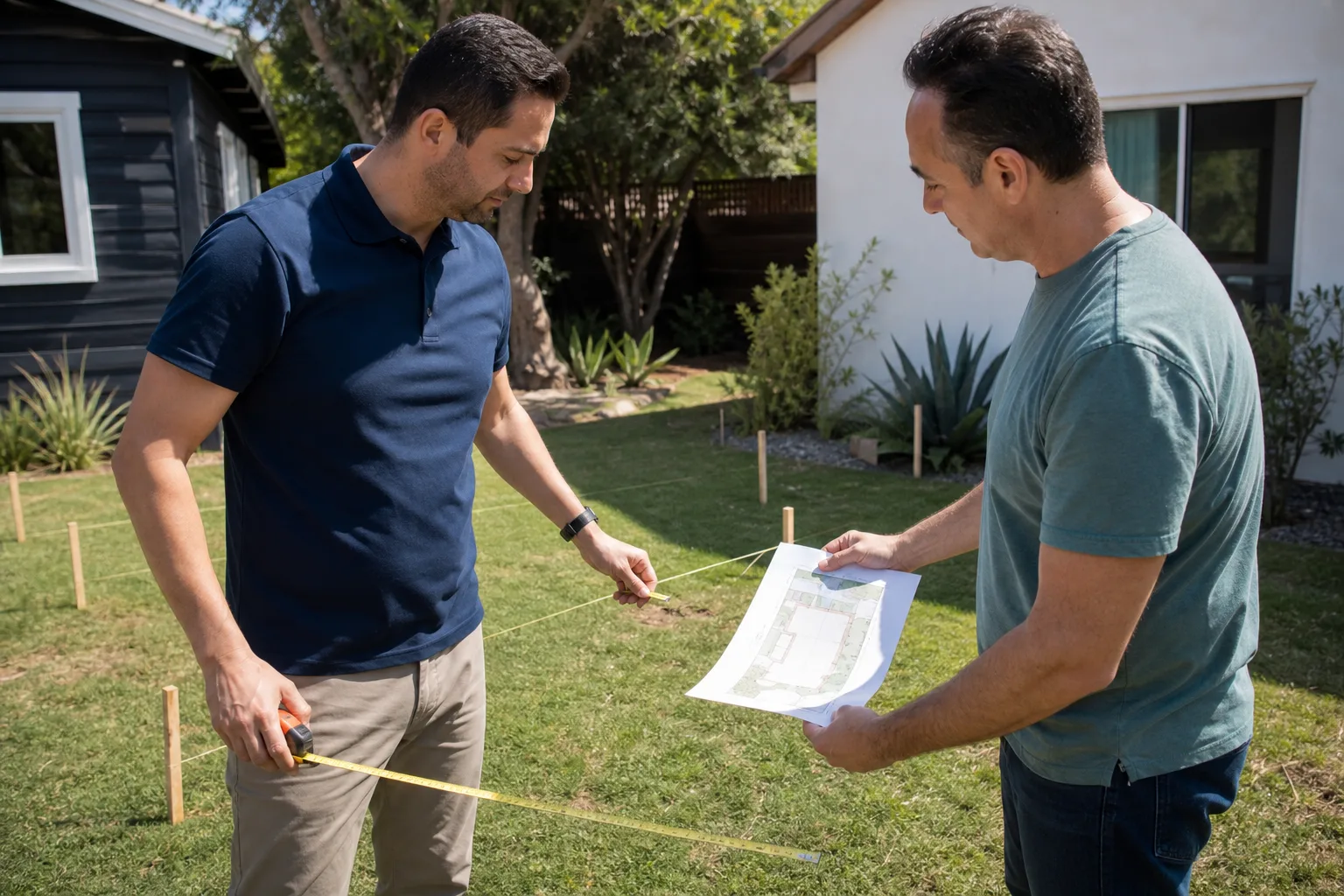
A legitimate builder writes the price down because a written price protects them too. It defines what’s included, what’s excluded, and what constitutes a change. When we sit down with a homeowner in Los Angeles, the written price is the first deliverable, not the last. The Threshold Standard we operate under requires a written price before a single tool is lifted on any ADU, garage conversion, or room addition. No exceptions.
What a verbal price really signals:
- No defined scope. If the scope isn’t written, it isn’t agreed. “We’ll figure out the electrical when we open the wall” is code for “you’ll pay whatever the electrician charges.”
- No accountability. A verbal number can’t be compared to anything. You can’t hold anyone to it because it never existed on paper.
- No permit plan. In Los Angeles, ADU permits require drawings, structural calculations, and title 24 energy reports. A contractor pricing verbally is pricing without a plan, which means the plan will come later at a cost they haven’t disclosed.
The fix is simple: if a builder hesitates to write the number down, ask why. The answer is usually more revealing than any contract you’ll eventually receive.
The Too-Low Bid: What a Cheap ADU Estimate Actually Hides
Most detached ADUs in Los Angeles run $180,000 to $320,000 before site work, depending on size, finish level, and whether you’re using a prefab product from a company like Dvele or Mighty Buildings or going fully custom. See our ADU Cost Breakdown: The Los Angeles Homeowner’s Reference for 2026 for a deeper dive into pricing. If a bid comes in at $120,000 for the same scope, that’s not a lucky find. It’s an exclusion list you haven’t seen yet.
Low bids work because they exploit the moment between excitement and scrutiny. You’re happy the project looks affordable, and you don’t want to ruin it by asking uncomfortable questions. But a low bid always hides something, and in our experience across Los Angeles ADU projects, it usually hides one of these:
- Site work excluded. Grading, tree removal, trenching for utilities, retaining walls. These can run $30,000 to $70,000 in Los Angeles hillside neighborhoods like Mount Washington or El Sereno, and a low bid conveniently omits them.
- Connection fees excluded. LADWP and LADBS fees for water, sewer, and electrical connections are real, and they’re not cheap. Some low bidders write “connections by owner” in the fine print.
- Finish allowance set absurdly low. A $15,000 kitchen allowance for an ADU sounds fine until you realize mid-range cabinets, counters, and appliances run $25,000 here.
- No contingency. Good builders include 5 to 10 percent for unknown conditions. Low bidders don’t, because the unknown conditions will become your change orders.
How to read a bid properly: put it side by side with another bid and look for what’s missing, not what’s listed. Missing line items are where the money hides. A bid that itemizes site prep, foundation, framing, rough electrical, rough plumbing, drywall, finishes, fixtures, appliances, and permits tells you the builder actually priced the job. A bid with three vague lines (“construction, finishes, cleanup”) is a gateway to change orders. Call (472) 248-8213 if you want a second set of eyes on a bid you’ve received in Los Angeles. We’ll tell you honestly if it’s realistic, even if you don’t hire us.
The Anonymous Crew: Why Not Knowing Who Shows Up Matters
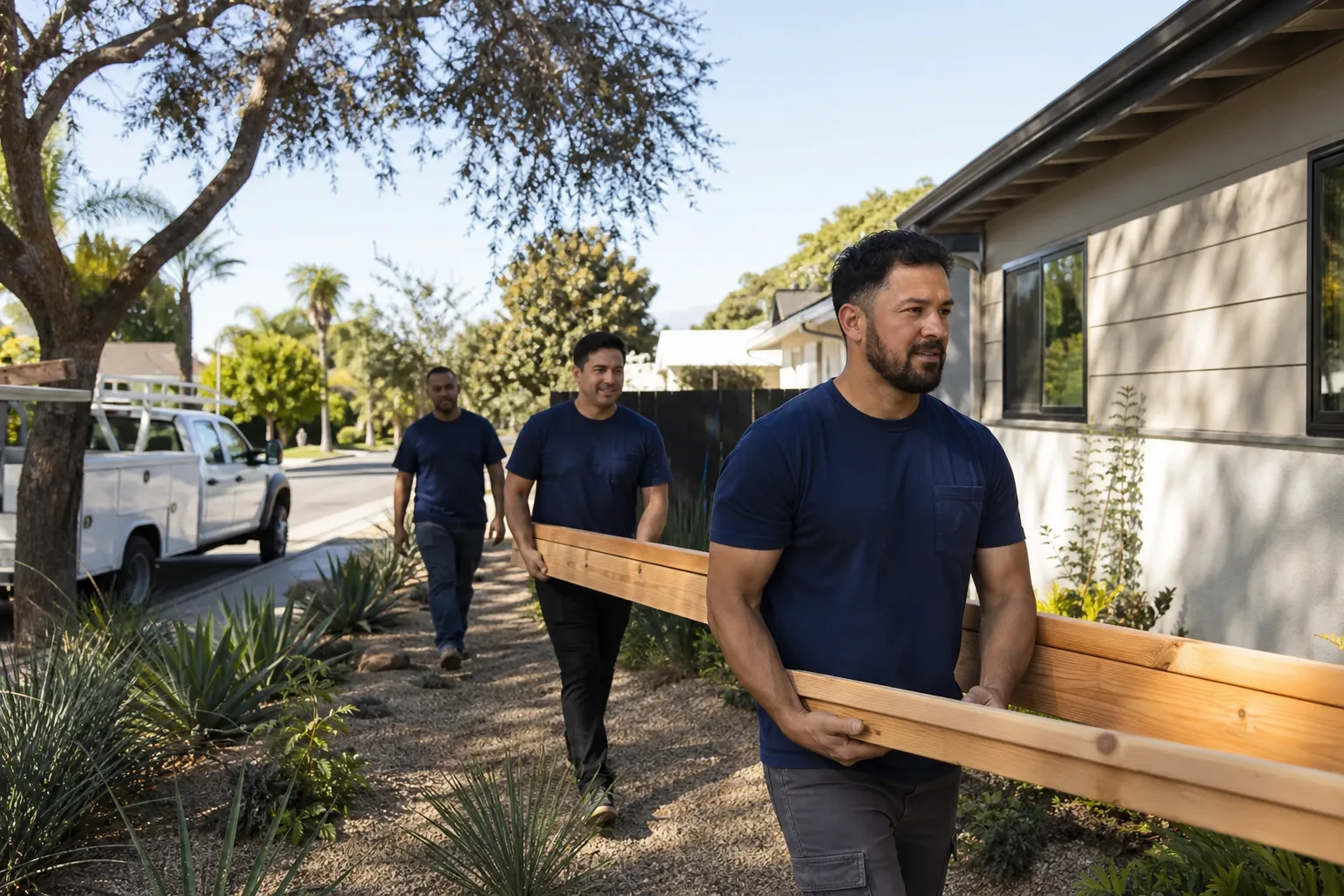
Here’s a scenario we hear from Los Angeles homeowners more than you’d expect. They sign a contract, pay a deposit, and on the first day of construction, three guys pull up in an unmarked truck and start unloading tools. The homeowner has never seen their names, doesn’t know if they’re employees or subcontractors, and can’t verify whether anyone on the property has been vetted at all. They’re told “they work with us all the time.” That’s supposed to be reassuring. It isn’t.
The crew-identity problem is actually two problems stacked on top of each other. The first is safety, and in Los Angeles, where many homeowners are often home alone, have young children, or are older and more cautious about who enters their property, this is not a minor concern. You’re opening your home, your garage, and your property line to strangers. You have a right to know who they are before they arrive.
The second problem is accountability. A subcontractor-heavy operation with no named, vetted employees is an operation where responsibility diffuses. If the framing is crooked, whose fault is it? The subcontractor blames the general contractor. The general contractor blames the subcontractor. You’re in the middle, paying everyone’s legal fees if it escalates.
This is why we built the Threshold Verified standard. Every technician who works on our ADU Builders services in Los Angeles is background-checked and identity-verified. You get their name and photo sent to you before the visit. They arrive in a clean, marked uniform and show a photo ID badge at the door, every time. Not sometimes. Not “on request.” Every time. It’s a system, not a promise, and it exists specifically because Los Angeles homeowners deserve better than an anonymous crew they couldn’t identify to police if something went wrong.
License and Insurance: What a CSLB Check Does and Doesn’t Tell You
Every legitimate ADU contractor in California carries a license issued by the Contractors State License Board (CSLB). You can check a license number at cslb.ca.gov in about thirty seconds. A license “in good standing” means the contractor has no active suspensions, no outstanding judgments that invalidate the license, and workers’ compensation insurance on file if they have employees.
Here’s what a good-standing CSLB license does not guarantee:
- It doesn’t guarantee ADU-specific experience. The CSLB issues a B (general building) license for a broad range of work. A contractor could have built nothing but commercial interiors for a decade and legally hold a B license. You want ADU-specific experience: someone who knows California ADU law, LADBS plan check requirements, and what Los Angeles zoning allows on your specific lot.
- It doesn’t guarantee financial stability. A license can be in good standing until the moment a contractor files bankruptcy or disappears with a deposit. License status is a snapshot, not a health record.
- It doesn’t guarantee the crew is vetted. A licensed contractor can legally hire day laborers with no background checks, no identity verification, and no accountability. The license covers the business entity. It says nothing about the individual humans who will stand in your kitchen.
Here’s what a legitimate license check looks like, step by step:
- Ask for the license number. If the contractor won’t give it, walk. This is not a negotiation.
- Go to cslb.ca.gov and verify the number matches the business name exactly. Variations like “Jon Smith Construction LLC” vs. “Jon Smith Builders Inc.” matter.
- Check for workers’ compensation insurance if the contractor has employees. No workers’ comp means you could be liable if a worker is injured on your property.
- Confirm the license covers the scope. An ADU requires a B license, not a C (specialty) license.
- Ask for a certificate of insurance naming you as additionally insured. This protects your homeowner’s policy from construction-related claims.
When you call Sutton ADU Builders at (472) 248-8213, we’ll provide our license information and certificate of insurance before you sign anything. That’s not a special favor. It’s the baseline for operating in Los Angeles.
Lien Waivers: The Paperwork That Protects Your Property Title
Most homeowners don’t think about mechanics liens until one is filed against their property. By then, it’s a legal problem with a timeline.
A mechanics lien is a legal claim against your property title that gives an unpaid contractor, subcontractor, or material supplier the right to force the sale of your home to recover what they’re owed. Let that sink in. If your general contractor fails to pay the electrician, the electrician can place a lien on your house. You paid the general contractor. It doesn’t matter. The lien is on your title, and you’re the one who has to clear it.
This is why lien waiver language matters. A lien waiver is a document signed by a contractor, subcontractor, or supplier that releases their right to file a lien for work paid to date. There are two basic types:
- Conditional waiver. Takes effect only when the payment clears. This is the standard, safe form for progress payments.
- Unconditional waiver. Takes effect immediately upon signing, regardless of whether the payment actually went through. You should never sign an unconditional waiver until the payment has cleared.
Vague lien waiver language is a red flag because it means the contractor’s paperwork discipline is loose, and loose paperwork is how liens happen accidentally. A clear contract specifies that you’ll receive a conditional lien release from the general contractor and from every major subcontractor with each progress payment. A vague contract says “lien releases as required” and hopes you won’t ask.
Ask this question before signing: “Will I receive lien waivers from every subcontractor and supplier with each payment?” If the answer is anything other than an unhesitating yes, that’s a flag. In Los Angeles, where ADU projects routinely involve ten to fifteen different trades and suppliers, a single missed waiver can create a title cloud that delays refinancing, selling, or inheriting the property. The fix is paperwork discipline, and paperwork discipline is non-negotiable.
Scope Creep: How Change Orders Turn a $200K ADU Into a $280K ADU
Scope creep sounds like something that happens to other people. In reality, it’s the most common way Los Angeles ADU projects go over budget. It happens in increments: an extra outlet here, upgraded tile there, a “small” foundation adjustment that adds a week of labor. Each change feels reasonable in isolation. Together, they add forty percent.
The mechanism is almost always the same. The original contract is vague. When an item comes up that wasn’t specified, the contractor classifies it as a change order, and change orders are priced at market rates with no bid pressure. You didn’t shop this price. You’re paying whatever they ask because the project is underway and stopping is unthinkable.
Here’s what a change-order-proof contract includes:
- Specific finish schedules. Not “mid-range flooring.” Actual products. Actual model numbers. Actual quantities.
- An allowance list with hard numbers. Cabinets, counters, appliances, fixtures, tile, lighting. If the allowance is written down, overage discussions start from a number, not a blank space.
- A written change-order process. Every change is written, priced, and signed before work proceeds. No verbal change orders. None.
- A contingency percentage stated up front. Five to ten percent for unknown conditions. If the contingency isn’t used, it’s returned. If it is used, you saw it coming.
We’ve seen Los Angeles homeowners save tens of thousands simply by asking “what’s your change-order process?” during the interview. The contractors with a clear process are the ones who’ve been through enough jobs to know that ambiguity costs money. The contractors without one are the ones who profit from it.
Red Flag Tiers: Walk Away vs. Ask First
Not every warning sign is a dealbreaker. Some are genuine red flags that should end the conversation immediately. Others are yellow flags, worth a clarifying question, because an honest answer can turn a yellow flag green. The problem with most “red flag” guides is they lump everything together, which makes every contractor look equally bad and leaves homeowners without a decision framework. Here’s ours.
Walk-away flags. These end the conversation:
- No written contract before work starts. Not a “we’ll get it to you next week.” Not a “we’re running behind on paperwork.” No contract, no project.
- No CSLB license or a license that doesn’t match the business name. This is illegal in California, not just risky.
- No workers’ compensation insurance with employees. You are personally liable if a worker is injured on your property. That’s not a small risk. That’s a financial catastrophe waiting.
- Requests for a deposit over $1,000 or 10 percent of the project total before any work begins. In California, the legal maximum deposit for home improvement contracts is $1,000 or 10 percent, whichever is less. A contractor asking for more is breaking state law.
- Pressure to sign “today” for a discount. Legitimate builders in Los Angeles are busy enough that they don’t need manufactured urgency. A shrinking price tag with a clock on it is a manipulation tactic.
- Refusal to provide references from completed ADU projects. Not “past projects.” ADU projects specifically. If they haven’t done one, they’re learning on your lot.
Ask-first flags. Worth a conversation:
- A low bid. Ask what’s excluded. Ask to see a line-item breakdown. If the explanation is specific and credible, the bid might just reflect a lean operation. If it’s vague, walk.
- A subcontractor-heavy crew. Subcontractors aren’t inherently bad. The question is vetting. Ask how subs are screened, who supervises them, and whether you’ll know who’s on site each day.
- A busy schedule that pushes your start date out three months. Annoying, but often a sign of demand, not disorganization. Ask for a written start date and a realistic timeline.
- An unfamiliar brand name in the proposal. Companies like Plant Prefab, Boxabl, and Cover are legitimate ADU product lines, but a contractor should be able to explain why they’re recommending that product for your lot. If they can’t, that’s a knowledge gap, not necessarily a fraud sign.
Common Mistakes to Avoid
- Taking a verbal price seriously. If it’s not written, it’s not real. A verbal quote in Los Angeles is worth exactly what you paid for it, which is nothing.
- Skipping the CSLB check because the contractor was “recommended by a friend.” Friends recommend based on personality, not paperwork. Check the license anyway.
- Paying a deposit before signing a contract. The contract defines what the deposit covers. Money first, paperwork later is how disputes start.
- Ignoring lien waiver language. You paid the general contractor. That doesn’t protect you if the general contractor doesn’t pay the subcontractor. Lien waivers are the only thing that does.
- Choosing the lowest bid without comparing line items. Three bids that vary by thirty percent aren’t a range. They’re a scope discrepancy. Find what’s missing.
- Assuming a CSLB license means the crew is vetted. It doesn’t. Ask specifically who will be on your property and what vetting they’ve undergone.
- Not asking about change-order process before signing. The way a contractor handles changes is the way they’ll handle everything else. Ask first.
When to Call a Professional
If you’ve received a bid that seems too low, a contract that’s vague about scope or lien waivers, or a proposal from a contractor who won’t put anything in writing, that’s the moment to get a second opinion. Not after you’ve signed. Before. A second set of eyes on a contract costs nothing and can save you tens of thousands. The same applies if you’re unsure whether a quote reflects realistic Los Angeles ADU costs, or if you’re weighing a prefab product like a Dvele or Mighty Buildings unit against a custom build and aren’t sure which fits your lot. Sutton ADU Builders offers free estimates in Los Angeles, call (472) 248-8213, and we’ll give you an honest read on your project, including whether the ADU you’re planning is even feasible under current LADBS and zoning requirements. No pressure. Just straight answers.
Frequently Asked Questions
The biggest red flags are no written contract, no verifiable CSLB license, no workers’ compensation insurance, a deposit request over $1,000 or 10 percent, and a refusal to provide ADU-specific references. Any one of these is serious, and three together means the contractor is either inexperienced or operating illegally. Call (472) 248-8213 for help evaluating a bid before you sign.
An unusually low bid usually means the contractor has excluded site work, connection fees, finish allowances, or contingency costs that a complete bid includes. You’ll pay for those items later as change orders, often at a higher rate because the work is already underway. Always ask for a line-item breakdown and compare what’s missing across bids.
Go to cslb.ca.gov, enter the contractor’s license number, and verify that the business name matches exactly and the license is in good standing. Confirm the license covers general building work (Class B), which ADU construction requires. Also ask for a certificate of insurance naming you as additionally insured. If you need help interpreting a license check in Los Angeles, call us at (472) 248-8213.
A mechanics lien is a legal claim against your property title filed by an unpaid contractor, subcontractor, or supplier, and it can force the sale of your home to satisfy the debt. You protect yourself by collecting conditional lien waivers from the general contractor and every major subcontractor with each progress payment, and by making sure your contract specifies this requirement in writing.
Most detached ADUs in Los Angeles run $180,000 to $320,000 before site work, with higher costs for hillside lots, complex foundation work, or premium finishes. Prefab products from companies like Boxabl or Plant Prefab can land on the lower end, while fully custom builds typically exceed $300,000. The exact number depends on your lot, your zoning, and your finish choices, which is why a written, line-item estimate is so important.
No. A CSLB license and insurance coverage apply to the business entity, not to the individual workers who arrive on your property. For related safety planning, see our ADU Emergency Preparedness Guide for Los Angeles Homes. If you want proof that specific people are background-checked and identity-verified, you need to ask for a crew vetting standard like the Threshold Verified process Sutton ADU Builders uses, where every technician’s name and photo are sent to you before they arrive.
The Bottom Line
The warning signs that matter most are the quiet ones: a verbal price, a vague contract, an anonymous crew, a missing line item in an otherwise complete bid. None of these are dramatic, and that’s exactly why they work. Los Angeles homeowners who discount them because they want the project to move forward are the ones who end up funding someone else’s learning curve. The fix is simple: written prices, verified identities, documented lien waivers, and a license you’ve actually checked. If a builder resist any of these, the answer isn’t to negotiate. It’s to walk. The right ADU builder in Los Angeles will prove who they are before you pay them a dollar.
Written by Miles Hartwell, Owner at Sutton ADU Builders home, serving Los Angeles since 2006. For honest guidance on your ADU project, including whether a Home Addition Contractor in Los Angeles or an ADU Builders in Los Angeles approach fits your lot, or if a Room Addition Contractor in Los Angeles is the better path, call (472) 248-8213.