Last updated October 9, 2026
DIY vs Professional ADU Builders: What’s Safe to Do Yourself
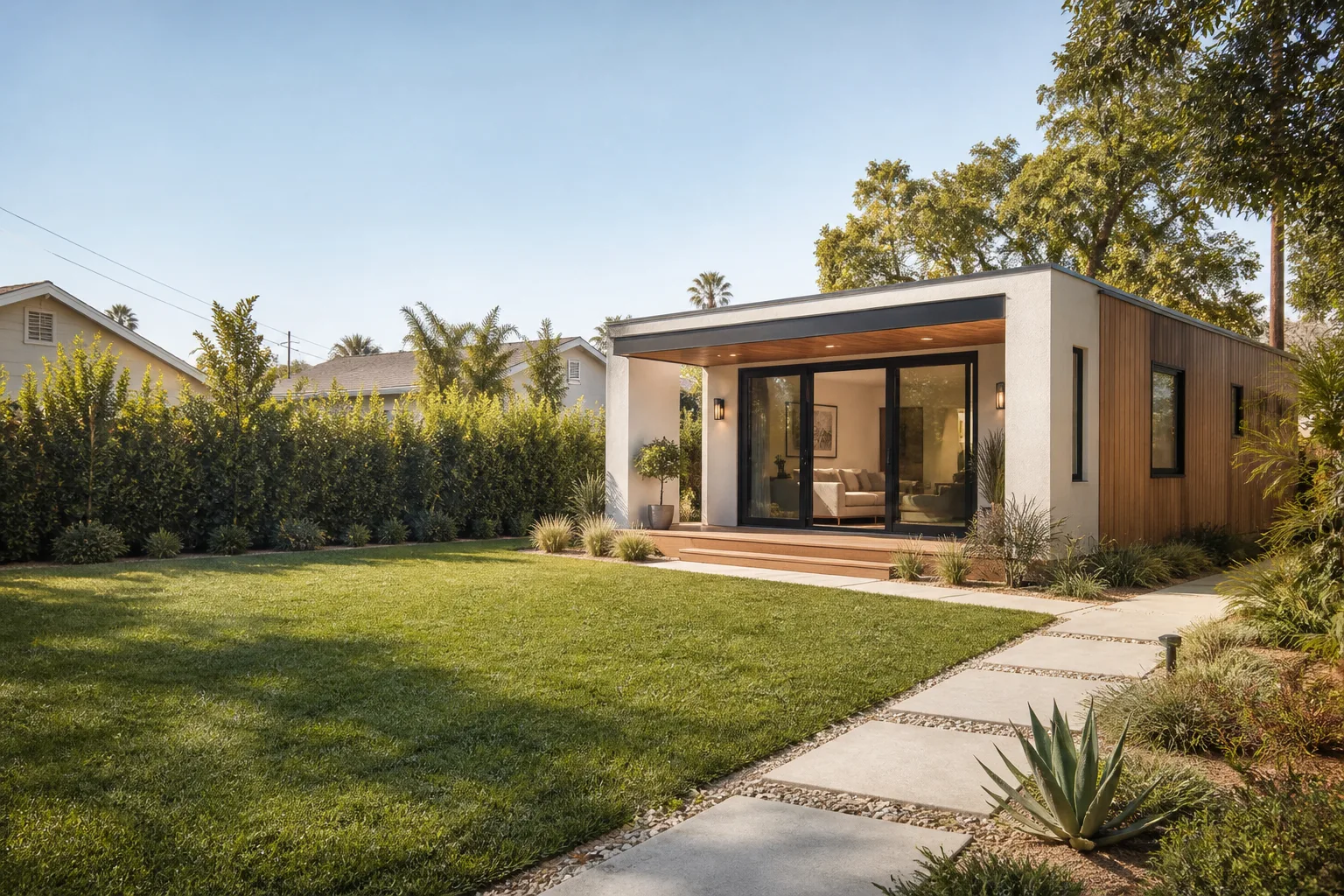
In Los Angeles, an accessory dwelling unit now carries the full legal weight of a standalone house. That single fact reshapes every DIY conversation. A garage conversion, a backyard cottage, a second-story addition over the garage: each one triggers the dwelling-unit provisions of the California Residential Code, and those provisions do not care whether you’re handy. They care about fire separation, egress windows, structural loads, and smoke detection. What follows is a straight answer to which parts of an ADU build a homeowner can reasonably take on, which parts California law effectively reserves for licensed ADU Builders, and what the owner-builder path actually costs when you account for time, inspections, and the rental income you forgo while the project drags.
Quick Answer
You can legally build your own ADU in California as an owner-builder, but you cannot legally perform electrical, gas, or load-bearing structural work without a licensed contractor’s supervision on a project of this type. The genuinely safe DIY scope on an ADU is narrow: site clearing, finish landscaping, interior painting after final inspection, and appliance installation after rough-in approval. Everything else carries code, lien, and insurance consequences that most Los Angeles homeowners discover only after a failed inspection. For the full picture, read our DIY vs Professional ADU: The Los Angeles Homeowner’s Decision Guide for deeper context.
Table of Contents
- What California Code Actually Says About DIY on an ADU
- Which ADU Tasks Are Genuinely Safe for DIY
- Which ADU Tasks California Reserves for Licensed Pros
- The Owner-Builder Declaration: What You Sign and What You Accept
- How to Price the True DIY Option
- Los Angeles-Specific Code and Permit Realities
- Common Mistakes to Avoid
- When to Call a Professional
- Frequently Asked Questions
- The Bottom Line
What California Code Actually Says About DIY on an ADU
California law does not prohibit a homeowner from acting as their own builder on an ADU. The state explicitly allows owner-builder projects under the Business and Professions Code, and the Los Angeles Department of Building and Safety (LADBS) will issue permits to an owner who signs the appropriate declarations. What the law does not allow is for an unlicensed owner to perform certain trades, even on their own property, when the structure must meet dwelling-unit standards.
Here’s the distinction that gets lost in most online discussions: a room addition that simply extends the footprint of your existing house enjoys some owner-friendly latitude in how the code interprets its systems. An ADU does not. An ADU is a second dwelling unit. That means the California Residential Code treats every system inside it the same way it treats the systems inside a brand-new standalone home. Fire separation between the ADU and the primary residence, independent egress from sleeping rooms, self-contained HVAC, dedicated electrical service or subpanel, and smoke and carbon monoxide detection that functions independently from the main house. These are not guidelines. They are adopted code provisions, and LADBS inspectors enforce them on every detached and attached ADU in Los Angeles.
So the real question is not “can I build my own ADU” but “which parts of this build can I perform without triggering a code violation, an insurance exclusion, or a mechanic’s lien.” The answer breaks down into two clean lists.
Which ADU Tasks Are Genuinely Safe for DIY
Owner participation in an ADU build genuinely reduces total cost in a small number of specific areas. These are tasks where the inspector is not evaluating specialized trade work, the risk of injury is low, and the finished result does not affect habitability or safety.
- Site clearing and demolition of non-structural elements. Removing old landscaping, pulling up a patio slab, or tearing out drywall inside a garage slated for conversion. This saves labor hours without touching anything structural.
- Interior painting after final inspection. Once LADBS signs off on the Certificate of Occupancy, painting walls, trim, and ceilings is entirely your call. Painting before final inspection is also allowed, but note that inspectors sometimes require drywall screws to remain visible in garages being converted, so confirm before you cover anything.
- Finish landscaping and hardscape outside the structure. Planting, irrigation, pavers, and garden walls are generally outside the building permit scope unless they affect drainage or fire access. Los Angeles hillside lots with brush clearance zones add a layer of fire code, so check your zone first.
- Appliance installation after rough-in is approved. Once the electrical and plumbing rough-in has passed inspection, setting a refrigerator, plug-in washer/dryer, or freestanding range into place is straightforward owner work. Do not wire a fixed appliance yourself. That falls squarely in the licensed category.
- Demolition debris hauling. Renting a dumpster and making runs to a Los Angeles construction and demolition waste facility is pure labor. It is safe, legal, and a meaningful cost savings on a project that generates several tons of debris.
These five areas typically represent 5% to 9% of a total ADU project cost when performed by the homeowner. That is worth doing. What it does not do is transform a $250,000 build into a $40,000 build. The big-ticket items remain the foundation, framing, mechanical systems, and finishes.
Which ADU Tasks California Reserves for Licensed Pros
California requires a licensed contractor for electrical, plumbing, and HVAC work performed for compensation. On an ADU, even when you are not paying anyone, the practical reality is that LADBS will not approve a permit for these systems without either a licensed contractor’s signature or an owner-builder declaration plus demonstrated competence, which is rarely accepted for dwelling-unit electrical service.
Here is the list of ADU components where you should not attempt the work yourself:
- Electrical service and subpanels. An ADU needs its own electrical service or a properly sized subpanel fed from the main panel. In Los Angeles, many older homes have 100-amp panels that cannot support an ADU’s load. Upgrading to a 200-amp service requires LADWP coordination, a licensed electrician, and sometimes trenching. A mistake here is not a failed inspection issue alone; it is a fire hazard.
- Gas lines and gas appliance connections. Any work on gas piping in California requires a licensed plumber with the appropriate CSLB classification. Gas is unforgiving. A slow leak inside a wall cavity is an explosion risk. This is not DIY territory, ever.
- Structural framing requiring engineer stamps. California is in Seismic Design Category D or E across most of Los Angeles. Foundation plans, shear walls, moment frames, and roof connections all require a California-licensed structural engineer’s stamp. An unlicensed person cannot produce those drawings, and LADBS will reject a permit submittal without them.
- Foundation and concrete work for a detached ADU. While there is no law preventing an owner from pouring their own foundation, an incorrectly formed or reinforced slab on a hillside lot in Silver Lake or Echo Park will fail inspection, and the remedial cost often exceeds the original concrete cost. This is an area where the error is discovered too late to fix cheaply.
- Fire-rated assemblies between an attached ADU and the primary residence. When you convert an attached garage, the shared wall and ceiling must meet a one-hour fire rating. This means specific drywall types, specific fastening patterns, and fire-blocking in every cavity. Install it wrong and the inspector will require you to tear it open. Install it “close enough” and you have a fire spread problem that no one will notice until it’s too late.
- Roofing on a detached ADU. Los Angeles building code requires specific nailing patterns, underlayment, and flashing details tied to your wind zone and fire zone. A roof that leaks also voids most workmanship warranties on everything below it. This is not hobby-level work on a dwelling unit.
What ties all of these together is that the code official reviewing your plans assumes a licensed professional performed the work. When that work falls short, the inspector’s remedy is not to walk you through a fix. The remedy is to red-tag the work, stop the project, and require a licensed contractor to correct it before construction may resume. The correction almost always costs more than hiring the pro from the start.
The Owner-Builder Declaration: What You Sign and What You Accept
The owner-builder path in California is legal, but it is not a loophole. When you sign the owner-builder declaration as part of your Los Angeles permit application, you are stating under penalty of perjury that you are building the project for your own occupancy or use and that you will either perform the work yourself or hire licensed subcontractors directly. You are not being granted a license. You are accepting the legal liabilities of a general contractor without any of the consumer protections that CSLB licensing provides.
The specific consequences are these:
- You forfeit CSLB protections. The Contractors State License Board exists to protect consumers from contractor fraud, substandard work, and abandonment. Those protections apply only when you hire a licensed contractor. As an owner-builder, you are the contractor. If a subcontractor you hired performs defective work, there is no CSLB complaint process that will help you. You fight that battle yourself, in court if necessary.
- You accept direct liability for worker injuries. When a licensed general contractor runs your job, their workers’ compensation insurance covers on-site injuries. An owner-builder who hires day labor or unlicensed help is personally liable if someone gets hurt. In California, a serious on-site injury can exceed what a homeowner’s policy will cover.
- You are directly exposed to mechanics’ liens. If you fail to pay a subcontractor or supplier, that party can record a lien against your property. A licensed GC manages lien releases and payment schedules as part of their job. The owner-builder becomes their own lien-waiver administrator, and miss one release and a supplier you never met can force the sale of your home to pay a bill you thought was settled.
- You cannot sell the property for 12 months after completion without penalty. California law restricts owner-builders from selling or leasing a property within one year of completing the work without triggering additional disclosure and escrow obligations. This matters if your ADU strategy includes a possible near-term sale.
In our experience building ADUs in Los Angeles, the owner-builder path makes real sense in exactly one scenario: you are a retired or semi-retired construction professional with deep trade relationships and the time to be on-site every day. For everyone else, the owner-builder declaration converts a manageable building project into a part-time general contracting job with no safety net. That is the honest trade-off.
How to Price the True DIY Option
The headline number on a professionally built ADU in Los Angeles lands between $180,000 and $320,000 for a typical one-bedroom detached unit with a kitchen and bath, before you account for site-specific work like retaining walls or utility trenching. A garage conversion runs lower, typically $120,000 to $200,000 depending on the condition of the slab and the need for new electrical service. Those are real ranges for 2025 and 2026, not placeholders.
The DIY owner-builder path, on paper, looks like a 30% to 40% savings because you are removing the general contractor’s markup and overhead. In practice, here is what an honest accounting of that path looks like for a typical Los Angeles homeowner:
- Your time. A self-managed ADU takes 12 to 18 months in Los Angeles versus 4 to 7 months for a professional build. If you value your time at even $30 an hour, 10 hours a week over 15 months is $19,500. At $50 an hour, it’s $32,500. This is a real cost you are paying yourself, and it is easy to ignore because no one sends you an invoice.
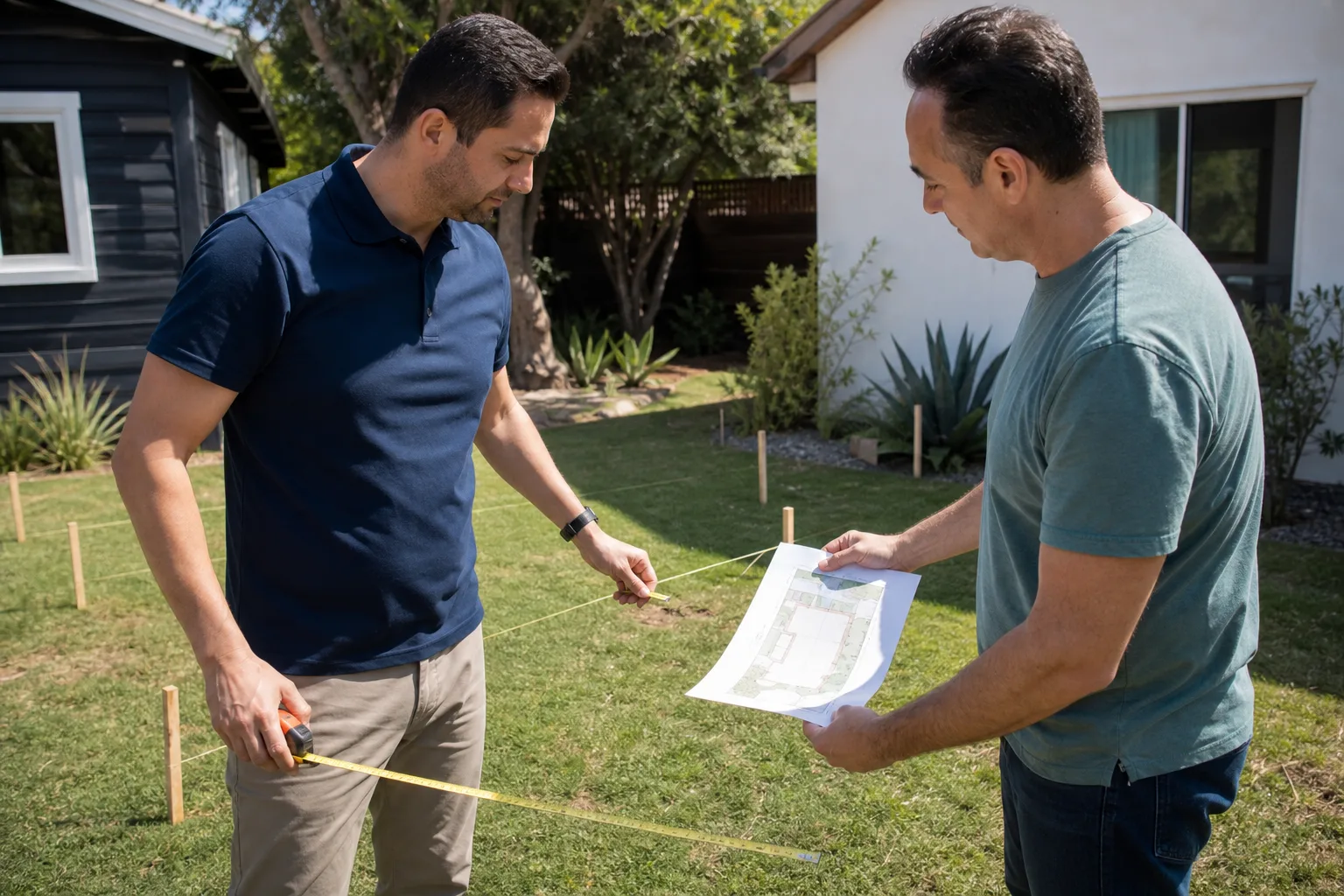
- The permit study curve. You will spend 40 to 60 hours learning LADBS plan-check standards, California Residential Code provisions, Title 24 energy calculations, and accessible path-of-travel requirements. That is not wasted time, but it is unpaid training you will never use again.
- Inspection failure costs. Each failed inspection in Los Angeles requires a reinspection fee and a construction delay. Failed structural or electrical inspections often mean tearing out and redoing work. Budget 8% to 12% of the estimated hard costs for re-work that a seasoned general contractor would not have needed.
- Rental income lost during delays. A one-bedroom ADU in Los Angeles rents for $1,800 to $2,800 a month depending on neighborhood. Every month of delay past the professional timeline costs you that income directly. An 8-month DIY delay equals $14,400 to $22,400 in forgone rent.
- Financing and insurance friction. Most construction lenders will not finance an owner-builder ADU at standard rates. Some will not finance it at all. And your homeowners insurance company may decline to extend coverage to the structure while it is under construction unless a licensed contractor is on the permit. Both of these can add thousands in carry costs you did not plan for.
When you add these line items together, the realistic savings from a full owner-builder ADU in Los Angeles shrinks to 8% to 15% of the project cost at best, and in some cases the owner-builder path ends up costing more than hiring a professional from day one. That is not an argument against DIY. It is an argument for knowing what the DIY option actually costs before you choose it, as explored in our DIY vs Professional Home Addition Contractor: What’s Safe to Do Yourself.
Los Angeles-Specific Code and Permit Realities
Building an ADU in Los Angeles is not the same as building one in Fresno or Bakersfield. Los Angeles has its own plan-check processes, its own inspector availability challenges, and its own geography that quietly shapes what your project will cost and how long it will take.
First, the LADBS plan-check timeline. A standard ADU permit submittal that passes on the first review takes 4 to 6 weeks. A submittal with structural redlines, Title 24 energy calculation errors, or fire-sprinkler questions can take 3 to 4 months. This is one of the quietest sources of owner-builder delay in Los Angeles, because a licensed design team knows which details trigger plan-check corrections and addresses them before the first submittal.
Second, the soils and foundation reality. Much of Los Angeles sits on hillside terrain or expansive soils. A detached ADU in Studio City or Mount Washington may need a soils report, deeper footings, or a retaining wall that a flat-lot ADU in North Hollywood does not. These are not optional upgrades. They are engineered requirements that flow from the geotechnical report, and they can add $20,000 to $60,000 to a project before framing begins.
Third, the fire zone overlay. Significant portions of Los Angeles are in Very High Fire Hazard Severity Zones. If your property is in one of these zones, your detached ADU will face additional exterior construction requirements: ignition-resistant siding, ember-resistant vents, and defensible space rules. A product line like James Hardie fiber cement siding is often specified on these lots because it meets the ignition-resistant standard without requiring costly masonry. A homeowner attempting to self-perform an ADU in a fire zone without understanding these overlay requirements will produce a plan set that plan check rejects on the first pass.
Fourth, the access and path-of-travel requirement. Every ADU in Los Angeles must include a code-compliant path of travel from the public right-of-way to the ADU’s entrance. This seems simple until you encounter a hillside lot with a 30-foot grade change. Meeting the accessibility requirement can require a stair system, a switchback path, or even a small lift in steep terrain. This is a plan-check issue, not a construction-afterthought issue.
Common Mistakes to Avoid
- Treating an ADU like a room addition. A room addition shares your home’s existing systems. An ADU must function as an independent dwelling. Applying room-addition logic to an ADU produces failed inspections on fire separation, egress, and mechanical systems. If you are in Los Angeles and weighing both paths, see how a Room Addition Contractor in Los Angeles scopes the difference in code requirements.
- Signing the owner-builder declaration without reading the liability provisions. The declaration is short, but its consequences are long. Read the section on workers’ compensation and mechanic’s liens before you sign anything.
- Going with a Tuff Shed: Tuff Shed structures can work as a starting point for an ADU conversion in Los Angeles, but the shed itself is not a permitted dwelling. The foundation, insulation, electrical, and plumbing work still require full permit review. Homeowners underestimate this and end up with an unpermitted structure they cannot rent or sell.
- Underestimating the electrical service requirement. Many Los Angeles homes built before 1980 have 100-amp panels. An attached ADU with electric appliances can push you past that. The panel upgrade is an LADWP process with its own timeline. Discover this at week three of your build and you lose a month.
- Skipping the Title 24 energy report. Every new ADU in California requires a Title 24 energy compliance report before plan check will accept the submittal. Homeowners who try to self-prepare this document almost always produce non-compliant calculations. This is a niche where the professional service costs $400 to $900 and the DIY version costs you a plan-check rejection.
- Assuming prefab means no site work. Factory-built units from companies like Plant Prefab solve the framing and finish quality problem, but they do not solve the foundation, utility trenching, site access, and crane placement problem. Your site still needs a Los Angeles permit, a soil evaluation, and often a crane that can reach the build location. A narrow Hollywood Hills street that a truck cannot navigate changes your math.
- Not reading the inspection sequence before you start. LADBS inspects in a specific order: foundation, rough electrical, rough plumbing, framing, insulation, drywall hanging (sometimes), final mechanical, final building. If you do not know this sequence before you start, you will cover up work the inspector needed to see. The result is reopening finished work, which is twice as expensive as doing it in order the first time.
When to Call a Professional
You should call a professional ADU builder when the project involves any licensed trade, when the lot has topography or fire-zone complications, or when the thought of managing subcontractors, lien releases, and inspection schedules for a year sounds like a second full-time job. In Los Angeles, the homeowners who most regret the owner-builder path are not the ones who lacked skill. They are the ones who underestimated how many separate disciplines a dwelling-unit build requires. A licensed ADU Builders in Los Angeles team coordinates structural engineering, Title 24 compliance, utility coordination, and inspections as a matter of course. That coordination is the actual product you are buying, not just the labor. Sutton ADU Builders offers free estimates in Los Angeles – call (472) 248-8213 to get a written price before you commit to any path.
Frequently Asked Questions
Yes, California law allows owner-builder construction of an ADU, but you cannot perform electrical, gas, or load-bearing structural work without licensed professionals, and you accept direct liability for workmanship defects, worker injuries, and mechanic’s liens by signing the owner-builder declaration. Most Los Angeles homeowners find the realistic savings do not justify the liability exposure. Call (472) 248-8213 to talk through your specific project without any sales pressure.
A professionally built one-bedroom detached ADU in Los Angeles runs $180,000 to $320,000 before site-specific work, while a garage conversion typically runs $120,000 to $200,000. The realistic owner-builder savings after accounting for time, inspection failures, financing friction, and lost rental income is 8% to 15% at best. For an exact quote on your lot, call (472) 248-8213 for a free estimate from Sutton ADU Builders home services.
You can safely handle site clearing, non-structural demolition, debris hauling, interior painting after final inspection, finish landscaping, and appliance installation after rough-in approval. Everything touching electrical, gas, structural, fire-rated assemblies, or foundations should involve licensed professionals. Start with the safe list and let a licensed contractor scope the rest.
The owner-builder declaration is a legal document you sign when pulling a building permit that identifies you, the homeowner, as the contractor of record. By signing it, you accept liability for worker injuries, subcontractor liens, and code compliance without CSLB consumer protections. It makes real sense only for experienced construction professionals.
Yes. The Tuff Shed structure itself may not require a contractor to purchase, but converting it into a legal dwelling unit in Los Angeles requires foundations, electrical, plumbing, insulation, and Title 24 energy compliance, all of which require permits and licensed trade work where the code specifies. The shed is the easy part; the dwelling-unit conversion is not.
A professionally managed detached ADU in Los Angeles typically takes 4 to 7 months from permit submittal to Certificate of Occupancy, while a self-managed owner-builder project routinely stretches to 12 to 18 months. The difference is mostly plan-check corrections, inspection scheduling, and trade sequencing. Every month of delay costs you rental income that could be offsetting the project. Call (472) 248-8213 to get a timeline specific to your property.
The Bottom Line
An ADU is legally a separate dwelling unit, and in Los Angeles that means the same code standards as a standalone house. You can legally act as your own builder, but the list of tasks you should not attempt yourself is longer than the list you should, and the financial gap between DIY and professional closes quickly when you account for time, failed inspections, financing friction, and forgone rent. The homeowners who benefit most from Home Addition Contractor in Los Angeles services are the ones who separate their capable enthusiasm from the code reality. Sutton ADU Builders exists to make the professional path a known quantity: a written price before work begins, a background-checked and photo-badged crew before anyone arrives, and a 365-Day Done Right Promise covering the completed work. If any element fails, the free second visit is part of the deal, no haggling. Call (472) 248-8213 and you’ll speak to a live person who can tell you exactly what your project requires.
Written by Miles Hartwell, Owner at Sutton ADU Builders, serving Los Angeles since 2006. Explore more guides & resources on ADU planning and construction.