Last updated October 9, 2026
ADU Warning Signs: A Los Angeles Homeowner’s Reference Guide
Most ADU fraud in California doesn’t start with a missing contractor. It starts with a signed contract that has no payment schedule tied to verified milestones, which means the homeowner funded work that never happened before anyone noticed. In Los Angeles, where a detached ADU commonly runs $180,000 to $320,000 before site work, the distance between “we’re behind schedule” and “the contractor stopped answering” is often measured in how much money has already left your account. This guide decodes the quiet signals: the procedural red flags on paper, the on-site behaviors that should stop you cold, and the specific steps to take in Los Angeles if you recognize a warning sign mid-project. For a broader overview, see The Complete Guide to ADU in Los Angeles. By the end, you’ll know what a healthy ADU contract looks like, how to spot a bad one before signing, and exactly what to do if things start going sideways.
Quick Answer
ADU contractor warning signs in Los Angeles fall into four categories: contract terms that lack a completion date or tie payments to unverified milestones, on-site crews who can’t identify themselves or post permits, financial asks like more than 10% down or cash-only payment demands, and communication patterns like unanswered written questions or pressure to skip inspections. The most reliable protection is a written price before work begins, a payment schedule tied to passed inspections, and a named crew whose identity is verified before they arrive.
Table of Contents
- Contract Red Flags That Show Up Before Anyone Lifts a Tool
- The Payment Schedule: Where Los Angeles ADU Projects Actually Go Wrong
- On-Site Red Flags: What You Should See and What Should Stop You
- Financial Red Flags: The Money Moves That Signal Trouble
- Communication Red Flags: When Silence Is a Warning Sign
- What to Do If You Recognize a Warning Sign Mid-Project
- Los Angeles-Specific Warning Signs: Permits, Setbacks, and Local Code
- Common Mistakes to Avoid
- When to Call a Professional
- Frequently Asked Questions
- The Bottom Line
Contract Red Flags That Show Up Before Anyone Lifts a Tool
A bad ADU contract in Los Angeles often looks fine at first glance. It has a price, a scope list, and a signature line. What it’s missing is what matters. The State of California requires contractors to include a license number on every contract, and the Contractors State License Board (CSLB) sets specific rules about down payments and change orders. When a contract ignores those rules, that’s not a clerical error. It’s a signal.
Here are the contract red flags we tell Los Angeles homeowners to look for before signing anything:
- No completion date. A contract without a written completion date is a contract without accountability. In Los Angeles, ADU projects are subject to permitting timelines at the Department of Building and Safety (LADBS), weather delays during winter rains, and material lead times. All of that can be scheduled around a date. If the contractor won’t commit to one in writing, walk away.
- A payment schedule not tied to passed inspections. Healthy ADU contracts in Los Angeles tie disbursements to verified milestones: foundation passed inspection, framing passed inspection, rough electrical passed inspection, and so on. A schedule that says “50% at start, 50% at end” or “progress payments as work progresses” gives the contractor your money without any independent verification that the work actually happened. This is the single most common contract risk we see in the Los Angeles ADU market.
- Missing license number. California law requires the contractor’s license number on all contracts, all bids over $500, and all advertising. If the number isn’t there, or if a CSLB lookup shows the license belongs to a different name or is suspended, stop. You can check any license at cslb.ca.gov in two minutes. Do it before you sign.
- An arbitration clause that limits CSLB complaint rights. Some Los Angeles ADU contracts include mandatory binding arbitration clauses that were added after a dispute provision was struck through or modified. Binding arbitration waives your right to file a complaint with the CSLB and can make recovery through the Contractor’s Bond far harder. Read the dispute-resolution section carefully. If it says you waive your right to file with any government agency, that’s a sign someone has been sued before and didn’t like how it ended.
- Vague scope language. “Build ADU to code” is not a scope. A real scope lists materials by name (or at least by grade and spec), dimensions, fixtures, finishes, and system allowances. Without that detail, “change order” becomes a monthly event. The contract should also state who is responsible for permit fees, school district fees, sewer connection fees, and utility connections, all of which add real dollars to a Los Angeles ADU.
Our advice is simple: if the contract doesn’t tie money to a verifiable event, don’t sign. The ADU Builders in Los Angeles who write honest contracts want that verification as much as you do. It protects both sides.
The Payment Schedule: Where Los Angeles ADU Projects Actually Go Wrong
The payment schedule is not a billing matter. It is the control mechanism for the entire project. When we examine failed ADU projects in Los Angeles, the pattern is nearly always the same: the homeowner paid too much too early, which removed every incentive the contractor had to finish.
California Business and Professions Code Section 7159 caps the down payment for any home improvement project over $1,000 at 10% of the total contract price, up to a maximum of $1,000 total. For a $250,000 ADU, that means the legal maximum you can be asked for at signing is $1,000. If someone asks for $25,000 to “secure the crew” or “buy materials,” they are asking you to break the law, and more importantly, they are telling you who they are.
After the down payment, a healthy Los Angeles ADU schedule looks something like this (our Complete ADU Builders Guide for Los Angeles Homeowners covers this in depth):
- 10% or $1,000 (whichever is less) at contract signing. That’s the legal maximum. Anyone asking for more is a red flag by definition.
- Foundation and site work, released after the foundation inspection passes. The LADBS inspector verifies the formwork, rebar, and setbacks before concrete is poured. That’s your trigger.
- Framing and rough systems, released after the framing and rough inspections pass. This includes rough electrical, rough plumbing, and mechanical. Each one gets its own LADBS sign-off.
- Drywall, exterior envelope, and windows. Payments at this stage should trail the work. Never pay in advance for materials not yet on your property.
- Final inspection and certificate of occupancy. The final payment should only be released when you have a signed final inspection card from LADBS and a walkthrough you’ve approved. This is the moment to confirm every item on the original scope is done.
The key principle: never let the total paid exceed the verified value of the work completed. If the contractor is asking for payment ahead of the work or between inspections, that’s how the schedule drifts into fraud territory. In our experience, the most dangerous sentence a Los Angeles homeowner can hear is, “I just need a little more to keep the crew moving.” That sentence means the contractor has already spent money that was supposed to be yours until the work was done.
A written price before work begins is not just a courtesy. It’s the baseline. At Sutton ADU Builders, every project gets a written, line-itemed price before a single tool is lifted, and the payment schedule is tied directly to LADBS inspection outcomes. That’s what a defensible schedule looks like.
On-Site Red Flags: What You Should See and What Should Stop You
Construction is noisy and messy, and it can be hard for a Los Angeles homeowner to know what’s normal and what’s not. But there are specific on-site signals that should stop you cold.
Here is what a healthy ADU job site in Los Angeles looks like, and what the opposite looks like:
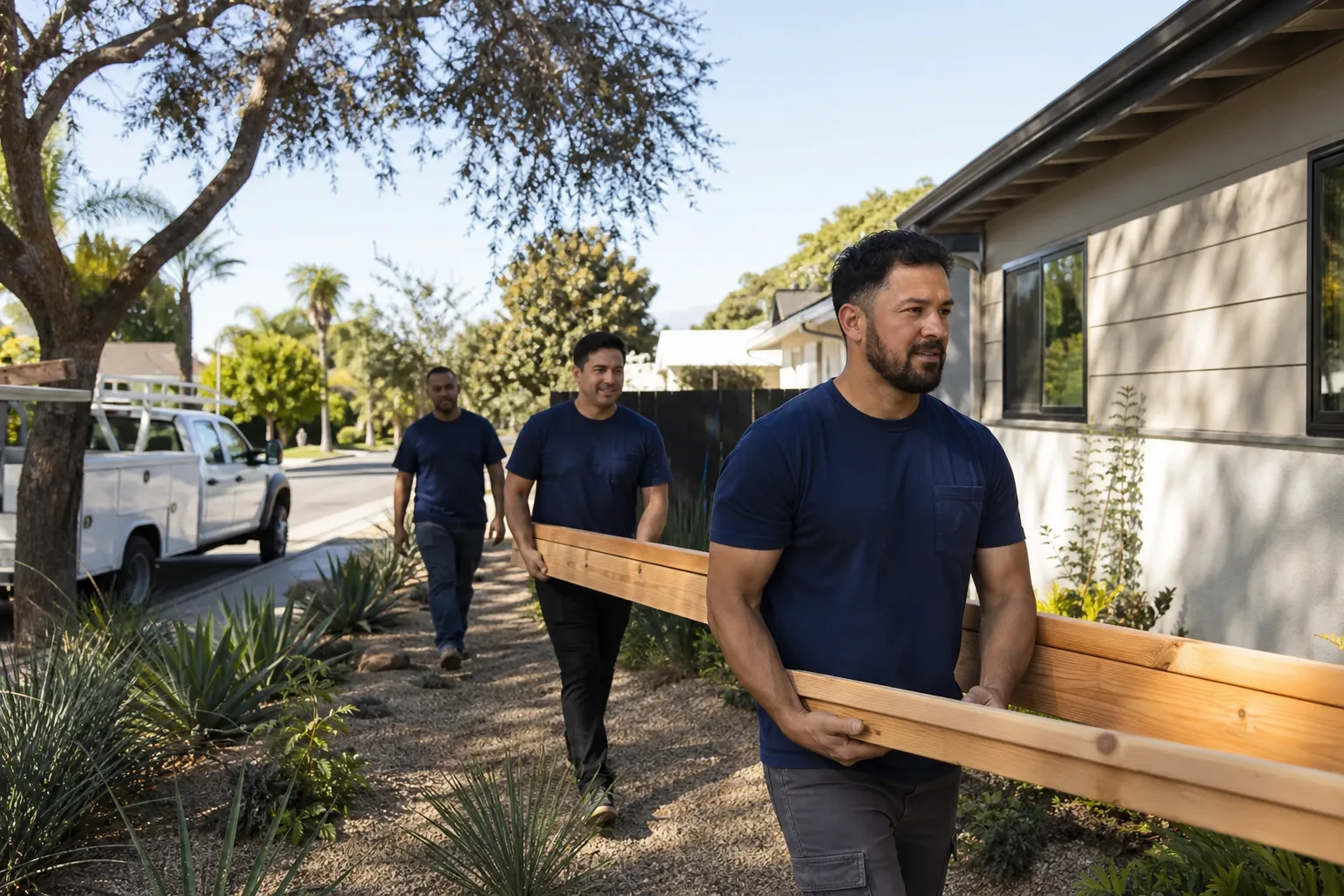
- Every person on site can identify themselves. If you walk out to your backyard and find people working who can’t tell you their names or who they work for, that is a problem. In Los Angeles, day labor hired off the books is common on residential projects, and it carries real risk: no workers’ compensation coverage, no accountability, and no one to answer for the work. Our crews are Threshold Verified, which means every technician is background-checked, identity-verified, and photo-badged. Before anyone arrives at your door, you get their name and their photo. If a contractor can’t tell you who is going to be on your property, think about what that means.
- The permit is posted. LADBS requires the building permit card to be posted on site in a visible location. If there’s no permit card, the work might be unpermitted. Unpermitted ADUs in Los Angeles create legal exposure: when you go to sell, the buyer’s lender may flag it, and you may have to tear out finished work to expose framing, electrical, or plumbing for inspection. Ask to see the permit card. If the contractor gets defensive about that question, that’s your answer.
- Materials match the contract. If the contract specified James Hardie fiber cement siding and you see a different, cheaper product on the lot, that’s a substitution. In California, material substitutions must be documented in a written change order signed by you. If the contractor swapped materials without telling you, they have broken the contractual chain. The same applies to windows, insulation, and sheathing.
- The site is clean enough to inspect. Some debris is normal. But a site that is consistently piled with trash, unsecured materials, and scattered fasteners is a site where the contractor doesn’t expect an inspection anytime soon. LADBS inspectors can and do red-tag sites they can’t safely access.
- Work stops after every inspection, not before. If the crew disappears right before a scheduled inspection and reappears after, or if you hear the phrase “we don’t need to get that inspected,” that is the single most important on-site red flag in Los Angeles. Inspections are the only independent verification you have that the work meets code. Skipping them saves the contractor time and exposes you to liability.
Most Los Angeles homeowners are not construction experts, and you shouldn’t need to be. But you should expect that everyone on your property can identify themselves, the permit is posted, and inspections are treated as non-negotiable.
Financial Red Flags: The Money Moves That Signal Trouble
ADU fraud in Los Angeles usually announces itself through money. The requests are often framed as reasonable, small, and urgent. They are none of those things. Here are the specific financial red flags to recognize.
The “more than 10% down” ask
As noted above, California law caps the down payment at 10% or $1,000, whichever is less, for any home improvement project over $1,000 total. That’s not a guideline. That’s the law. A Los Angeles contractor who asks for 20%, 30%, or 50% down is either ignorant of the law or hoping you are. Either way, it’s a disqualifying red flag. On a $250,000 detached ADU, the legal maximum down payment is $1,000. If someone asks for $25,000 to start, you are dealing with someone who is already violating California statute before the first shovel of dirt moves.
Cash-only payment demands
There is no legitimate reason for a licensed Los Angeles ADU contractor to require cash payments. Checks and bank transfers leave a paper trail, which protects everyone. Cash leaves no trail, and it is the preferred payment method of unlicensed operators and contractors trying to avoid wage reporting, tax liability, and liability insurance premiums. If you’re asked to pay in cash, or if you’re offered a “discount for cash,” you’re being asked to fund an off-the-books project. The CSLB can’t help you recover cash payments from an unlicensed operator. The Contractor’s Bond doesn’t cover cash paid outside the written contract. You would be entirely unprotected.
“Pay the supplier directly” requests
This one deserves special attention because it sounds responsible. The contractor says, “the lumber yard needs a deposit, can you pay them directly?” What that actually means: the contractor may have maxed out their credit with the supplier, or they may be structuring payments outside the contract. Direct supplier payments break the payment schedule you signed. They also create a gray legal area if the project stalls: you may have paid for materials that were delivered to the job site and then removed, or materials that were never ordered. All payments should flow through the written contract, tied to the milestones you both signed.
Escalating requests framed as “short-term”
A request for an extra $5,000 to “keep things moving” is a structural problem, not a cash-flow problem. In our experience working with Los Angeles homeowners who have been through failed builds, the first out-of-schedule money request is the leading indicator of a project that will stop within 60 to 90 days. Once a contractor breaks the payment schedule the first time, the schedule no longer controls the project.
The fix is not to negotiate with a contractor who is asking for illegal or off-schedule payments. The fix is to choose a builder whose entire pricing model makes those requests impossible. A written price before work begins, delivered before a single tool is lifted, is the baseline. At Sutton ADU Builders, that’s the Threshold Standard, not an add-on.
Communication Red Flags: When Silence Is a Warning Sign
Los Angeles homeowners often tell us that they didn’t realize their project was in trouble until the contractor stopped responding. But the silence was building for weeks before it became total. Here’s what the quiet deterioration looks like.
Written questions go unanswered
You send an email asking about a delayed inspection or a material substitution. You get a phone call instead of an email. Then you get nothing. Then you get a text saying “we’ll talk about it on site.” What’s happening: the contractor is avoiding a written record. In a dispute, the written record is what the CSLB, a mediator, or a court will look at. A contractor who refuses to answer in writing knows that. Healthy contractors answer in writing. At Sutton ADU Builders, all project communication that involves money, scope, or schedule has a written trail. If it isn’t written, it didn’t happen.
The supervisor contact changes without notice
ADU projects in Los Angeles typically run 6 to 12 months from permits to final inspection. It’s normal for different tradespeople to rotate through. It is not normal for the person you were told to call to change three times without any explanation. If the project supervisor keeps changing, or if the office says “we’ve got someone new on that job” without telling you why, that’s an internal stability problem that will become your problem.
Pressure to skip an inspection “to save time”
This is the communication red flag that Los Angeles homeowners should treat as a hard stop. Inspections add days to the schedule, but they are the only independent verification you have that the work is safe and legal. A contractor who suggests skipping one is asking you to accept unverified work on a structure you will live in or rent to tenants. If they frame it as “I’ve done this a thousand times, we don’t need the city out here,” thank them for their opinion and schedule the inspection yourself. LADBS inspection requests can be made by the homeowner. You don’t need the contractor’s permission.
Deflection and vague updates
“We’re just waiting on a few things.” “You wouldn’t understand the technical details.” “Let me get back to you on that.” These are not updates. A healthy ADU project in Los Angeles is trackable: you should know what was done last week, what’s scheduled next week, and what’s holding. If the contractor can’t or won’t provide that, you’re being managed, not communicated with.
A live person answering every call isn’t a luxury. It’s a basic signal that the company you hired still exists and is still accountable. At Sutton ADU Builders, when you call, a live person answers, 24 hours a day, 7 days a week, no voicemail trees. If your current contractor’s phone goes to a generic mailbox, start documenting. That’s a signal.
What to Do If You Recognize a Warning Sign Mid-Project
Recognizing a red flag does not mean the project is lost. But it does mean the way you manage the project has to change. Here are the specific steps we recommend to Los Angeles homeowners who spot trouble mid-build.
- Stop paying off-schedule. If the contractor asks for money outside the written milestones, the answer is no. That single word resets the power dynamic. You can always release a payment later if the issue gets resolved. You cannot get money back once it’s gone.
- Document everything in writing from this point forward. Send a dated email or letter to the contractor summarizing your concerns and the specific items you want addressed. If a verbal conversation happens, follow up with an email: “This is to confirm what we discussed today.” The written record is your evidence.
- Verify the license and bond. Go to cslb.ca.gov and check the contractor’s license status. If it’s suspended, expired, or revoked, the project is at serious risk. The CSLB can also tell you whether there have been prior complaints or bond payouts.
- Do not fire anyone in the middle of a payment dispute without legal advice. Terminating a contractor mid-project in California can trigger a mechanics lien claim, a breach claim, or both. Before you make that move, call a construction attorney in Los Angeles. A $400 consultation is cheap compared to a lien fight.
- Understand mechanics liens. In California, subcontractors and material suppliers who aren’t paid can file a mechanics lien against your property even if you paid the general contractor in full. If you get a Preliminary 20-Day Notice from a sub or supplier, that’s normal and doesn’t mean there’s a problem yet. But if the GC stops paying their subs, those liens land on your property. If you suspect that’s happening, talk to the subs directly and ask if they’ve been paid. It’s awkward. It’s also your property on the line.
- File a CSLB complaint if there’s a license violation. The CSLB has jurisdiction over licensed contractors. Filing a complaint is free and can be done online. It won’t get your money back quickly, but it creates an official record and can lead to license discipline, which can motivate a contractor to settle.
- If the project has stopped completely, get a written status report from the contractor. Ask for a written list of what’s done, what’s pending, and a date they will resume. If they won’t provide one, that failure becomes part of the record if you need to terminate and seek recovery.
Pausing a project is sometimes the right call. But pausing without documentation is how homeowners lose their position. Get everything in writing, stop out-of-schedule payments, and get professional advice before you make any irreversible move.
Los Angeles-Specific Warning Signs: Permits, Setbacks, and Local Code
Los Angeles has one of the most complex residential permitting environments in the country, and ADU regulations here have shifted significantly over the last decade. State law has made ADUs easier to permit, but the local execution still has wrinkles that create specific warning signs.
The permit timeline that never starts
LADBS plan check for a standard ADU can run 4 to 8 weeks. If your contractor signed a contract and then went silent on the permit process for months, that’s not normal. They may be unpermitted, they may have submitted incomplete plans and not told you, or they may have had the plans rejected and be avoiding the conversation. Ask to see the LADBS plan check status online. It’s publicly searchable by address. If the contractor won’t give you the plan check number, that’s a warning sign.
Setback claims that don’t match your lot
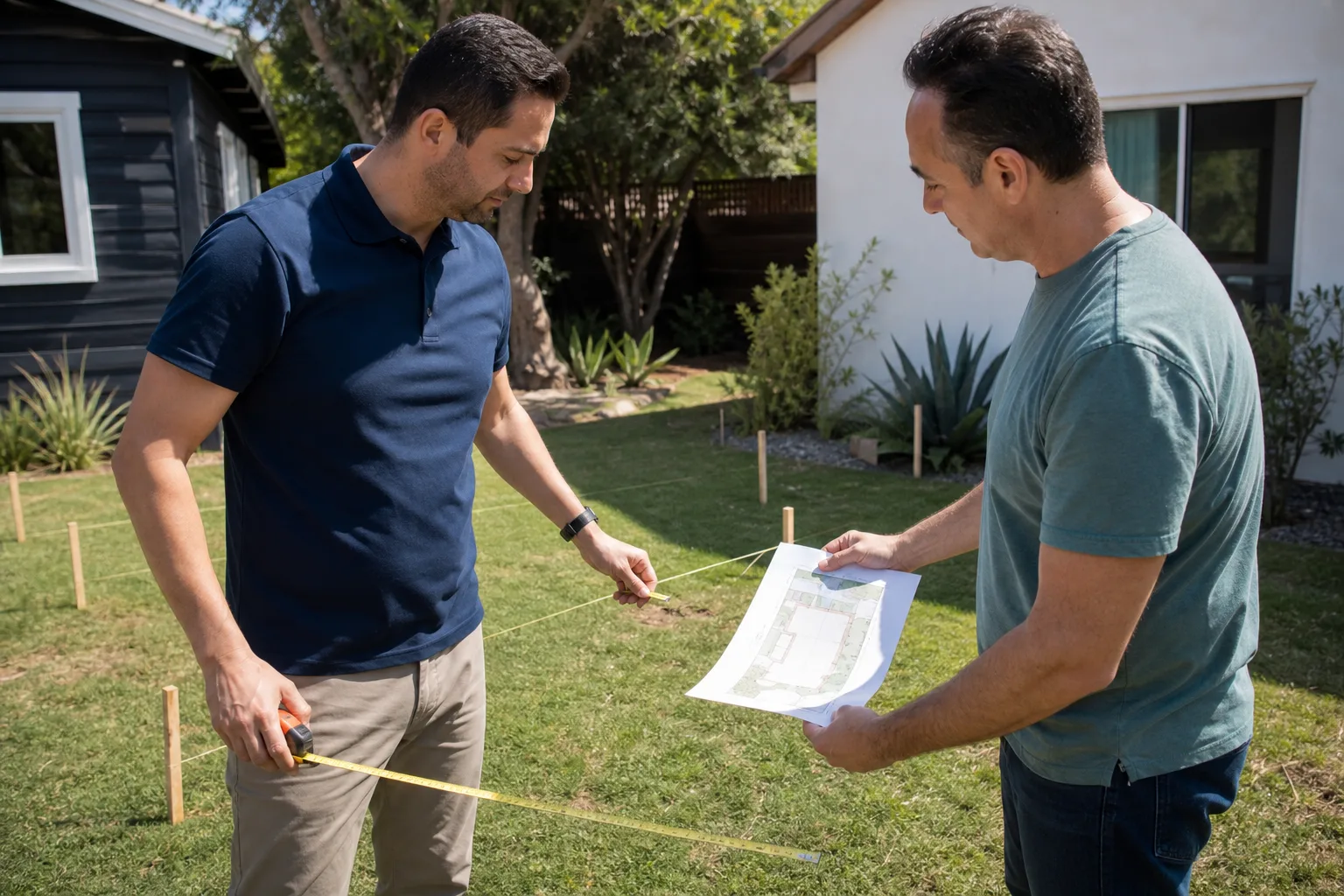
Los Angeles ADU setbacks (the required gap between your new structure and the property line) are generally 4 feet for side and rear yards, but there are exceptions for conversions of existing structures and for certain small lots. A contractor who brushes off setback questions with “we’ve handled the city” or “state law overrides local setbacks” is either oversimplifying or wrong. Your plot plan should show the proposed structure’s distance to every property line, and LADBS will verify it during plan check and inspection. In our experience, the homeowners who ask for the plot plan early are the ones who don’t get surprised later.
The garage conversion that never confirms sewer lateral capacity
Converting a garage to an ADU in Los Angeles often triggers utility questions: sewer capacity, water service sizing, and electrical panel capacity. A contractor who never mentions these items is either planning to skip the permits or has not actually looked at your lot conditions. These are not optional details. They are the difference between a permitted ADU you can rent out and a structure that becomes a liability.
Soil and foundation assumptions
Los Angeles sits on a mix of soil types, from compacted alluvium in the valleys to hillside conditions in areas like Silver Lake, Echo Park, and Mount Washington. On hillside lots, foundation engineering is not a guess. A contractor who prices a hillside ADU without a soils report and without a structural engineer’s foundation plan is pricing fiction. If the price seems too good to be true on a Los Angeles hillside, it almost certainly is.
Local knowledge matters here. We’ve worked with prefab and modular brands like Abodu, Cover, and Dvele, and each has different engineering assumptions for Los Angeles lots. See our guide on Choosing the Right ADU Brand: A Buyer’s Guide for Los Angeles. A contractor who works across these product lines should be able to tell you which one actually fits your setback, your soil, and your budget. If they can’t, that’s the conversation to have before signing.
Common Mistakes to Avoid
- Accepting a verbal scope. “We’ll handle it” is not a scope. If it isn’t written, it doesn’t exist. Insist on a written scope with materials, dimensions, and finishes specified. In Los Angeles, a vague scope becomes a change-order factory.
- Paying for “materials” before they arrive. A request for material money up front is often a red flag disguised as logistics. Verify materials are on your property before releasing any payment tied to them.
- Signing a contract with no completion date. Without a date, there is no delay to point to. The contract should state a realistic completion window and what happens if it’s missed.
- Assuming the highest bid is the safest bid. High bids can hide the same procedural red flags as low bids. Evaluate the contract terms, the license, the inspection schedule, and the crew standards, not just the number.
- Ignoring the Preliminary 20-Day Notice. These notices from subs and suppliers are a standard part of Los Angeles construction. File them. If the GC stops paying, those notices tell you who might file a lien against your property.
- Skipping the CSLB license check because “the reviews looked good.” Reviews can be bought, deleted, or fabricated. The license is verified by the State of California. Check it every time, on every contractor.
- Letting the contractor register the ADU under their own contact information. The LADBS correspondence and inspection notices should come to you. If all city communication goes through the contractor, you’re flying blind. Confirm your email and phone number are on the permit application.
When to Call a Professional
You should call a professional the moment a red flag trips, not after it compounds. Specifically: if you’ve been asked for more than the legal 10% down payment, if the crew on your property can’t identify themselves, if the permit isn’t posted, if the contractor is pressuring you to skip an inspection, or if out-of-schedule money requests have started. Those are not situations to manage with patience. They are situations to manage with documentation and a second professional opinion.
You should also call before signing anything. A qualified Los Angeles ADU builder will walk your lot, answer written questions in writing, show you the plot plan, and give you a price that doesn’t change unless the scope changes in a written change order you signed. Sutton ADU Builders home services all of Los Angeles with free estimates. If you’re comparing contractors, ask each one the questions in this guide and see who answers in writing. That tells you most of what you need to know.
Sutton ADU Builders offers free estimates in Los Angeles. Call (472) 248-8213 and a live person will answer, 24/7. Explore more guides & resources on our blog.
Frequently Asked Questions
California law caps the down payment for any home improvement project over $1,000 at 10% of the contract price, up to a maximum of $1,000 total. For a $250,000 ADU, the legal maximum is $1,000 at signing. Anyone asking for more is violating California Business and Professions Code Section 7159. Call (472) 248-8213 if you want a legitimate written quote that follows the law from the first line.
They can ask, but you should not pay. A healthy payment schedule releases money only after the relevant LADBS inspection passes. Paying before the inspection removes your only independent verification that the work is real. If your contractor is pushing for pre-inspection payment, document the request in writing and stop the payment schedule until you get professional advice.
First, don’t let the situation escalate. Ask for the general contractor’s supervisor. Then document what you saw: names, dates, and descriptions. Ask the contractor in writing who was on your property and confirm they carried workers’ compensation coverage. At Sutton ADU Builders, every technician is Threshold Verified: background-checked, identity-verified, and photo-badged, with their name and photo sent to you before they arrive. If your contractor can’t provide that, that’s the signal.
Yes. LADBS plan check for ADUs commonly runs 4 to 8 weeks, and the permit card must be posted on site. Hillside lots in areas like Mount Washington or Echo Park require soils reports and structural engineering that flat-lot builds don’t. If your contractor never mentions soil, setbacks, or sewer lateral capacity, or if they say the city doesn’t need to inspect, treat it as a warning sign. Ask for the LADBS plan check number. If they won’t give it to you, call (472) 248-8213 for a second opinion.
The 365-Day Done Right Promise is Sutton ADU Builders’ written guarantee that covers defects in workmanship for one full calendar year from project completion. If something isn’t right within that year, we make it right, including a free second visit if an element of the build fails. It’s a named, written promise, not a verbal assurance. Call (472) 248-8213 and we’ll send you the actual guarantee language before you sign anything.
Not if you have the right contract. Los Angeles homeowners tell us the most common surprise is a “change order” that was never discussed. At Sutton ADU Builders, every homeowner receives a written price before any work begins, and the price doesn’t change unless the scope changes in a written change order you sign. If your current contractor’s price is drifting without your signature, that’s a red flag. Get a free written estimate by calling (472) 248-8213.
The Bottom Line
ADU warning signs in Los Angeles are rarely dramatic. They don’t start with a vanished contractor. They start with a contract that had no completion date. A payment schedule that wasn’t tied to passed inspections. A crew that couldn’t identify themselves. A permit that was never posted. A supervisor who changed without notice. A request for more than 10% down. The good news is that every one of those signals is detectable before the job goes bad, and every one is in your control at the signing table. The written price, the named crew, the inspection-linked payment schedule, and the 365-day written promise are not extras. They’re the floor. If a Los Angeles contractor can’t meet that floor, you have your answer. Our Home Addition Contractor in Los Angeles team works to that standard on every project, and our Room Addition Contractor in Los Angeles services follow the same threshold. Call (472) 248-8213 for a free estimate and a written price before any work begins.
Written by Miles Hartwell, Owner at Sutton ADU Builders, serving Los Angeles since 2006.