Last updated October 9, 2026
The Complete Home Addition Contractor Guide for Los Angeles Homeowners
Here’s a statistic that ought to keep every Los Angeles homeowner up at night: LADBS issues permits for roughly 50,000 residential projects a year, but a staggering amount of unpermitted work slides through anyway, and it almost never shows up until the day you try to sell. The buyer’s inspector finds the addition. The appraisal comes in low. The escrow stalls. That’s not paranoia; it’s the reality of buying and selling homes in a city where garages become bedrooms, porches become studies, and nobody asked the city first. This guide exists to keep you out of that trap. We’ll cover how Los Angeles permit bureaucracy really works, which questions expose a contractor who lacks genuine LA experience, and what a California-compliant written price must contain before you sign anything. Sutton ADU Builders has been doing this since 2006, and we’ve watched too many smart homeowners learn these lessons the expensive way.
Quick Answer
A home addition contractor in Los Angeles should be judged less on whether they can frame a wall and more on whether they can navigate LADBS plan check, hillside grading rules, and Home Improvement Contract law without flinching. The right contractor pulls permits under their own license (never yours), delivers a written price before starting, and can explain exactly how LA’s zoning code applies to your specific lot. Expect to pay $250 – $550 per square foot for a quality addition in Los Angeles, depending on scope, soil, and site constraints.
Table of Contents
- Why Los Angeles Is a Different Beast for Home Additions
- The Permit Gauntlet: LADBS vs. Surrounding Cities
- Soft-Story, Hillside Grading, and Soil Reality Checks
- The Owner-Builder Permit Trap (And How to Avoid It)
- Nine Questions That Expose a Contractor’s Real LA Permit Experience
- What a Written Locked Price Must Contain in California
- Prefab and Modular Options: When They Make Sense in LA
- Common Mistakes to Avoid
- When to Call a Professional
- Frequently Asked Questions
- The Bottom Line
Why Los Angeles Is a Different Beast for Home Additions
Adding square footage in Los Angeles is not the same as adding it in Dallas, Phoenix, or even Ventura. The reasons pile up fast. First, the city’s zoning code is a dense 700-plus-page document that has been amended, reinterpreted, and patched so many times that even experienced builders keep a consultant on speed dial. Second, Los Angeles sits on a patchwork of soil types that range from stable decomposed granite in the hills to expansive clay in the flats, and your foundation design depends on knowing which one you’re on. Third, the city’s building stock is old. A significant share of single-family homes in Los Angeles were built before 1960, which means asbestos, lead paint, outdated electrical panels, and framing that doesn’t meet current seismic codes. A contractor who mostly builds in newer suburban subdivisions is going to be lost in a 1940s LA bungalow.
Then there’s the bureaucratic reality. Los Angeles processes additions through LADBS, which has its own plan check system, its own inspectors, and its own rhythm. The plan check for a simple room addition can take four to eight weeks before you even get a permit number. A more complex addition with a second story or a hillside retaining wall can take four months or more. Contractors who don’t work regularly in Los Angeles tend to underestimate that timeline by half, and then the project stalls because the crew was scheduled on the assumption that permits would arrive in thirty days.
We’ve also seen how neighborhood context shapes feasibility. Additions in Sherman Oaks and Studio City often trigger additional review because of hillside grading or fault proximity. Homes in Brentwood and Pacific Palisades may fall into Very High Fire Hazard Severity Zones, which changes the cladding requirements, the glazing, and sometimes the entire material budget. A contractor who doesn’t ask which zone you’re in during the first meeting is revealing a gap in local knowledge.
Sutton ADU Builders has always argued that the real work of a home addition in Los Angeles happens before a single shovel hits soil: plan check strategy, code interpretation, and a written price that accounts for what the city will actually require. For a deeper look at this process, see The Complete Room Addition Contractor Guide for Los Angeles Homeowners. That’s why we anchor every project in the Threshold Standard: a written price before work begins, a 365-Day Done Right Promise covering workmanship, and a crew you’ve met on paper before they ring your doorbell.
The Permit Gauntlet: LADBS vs. Surrounding Cities
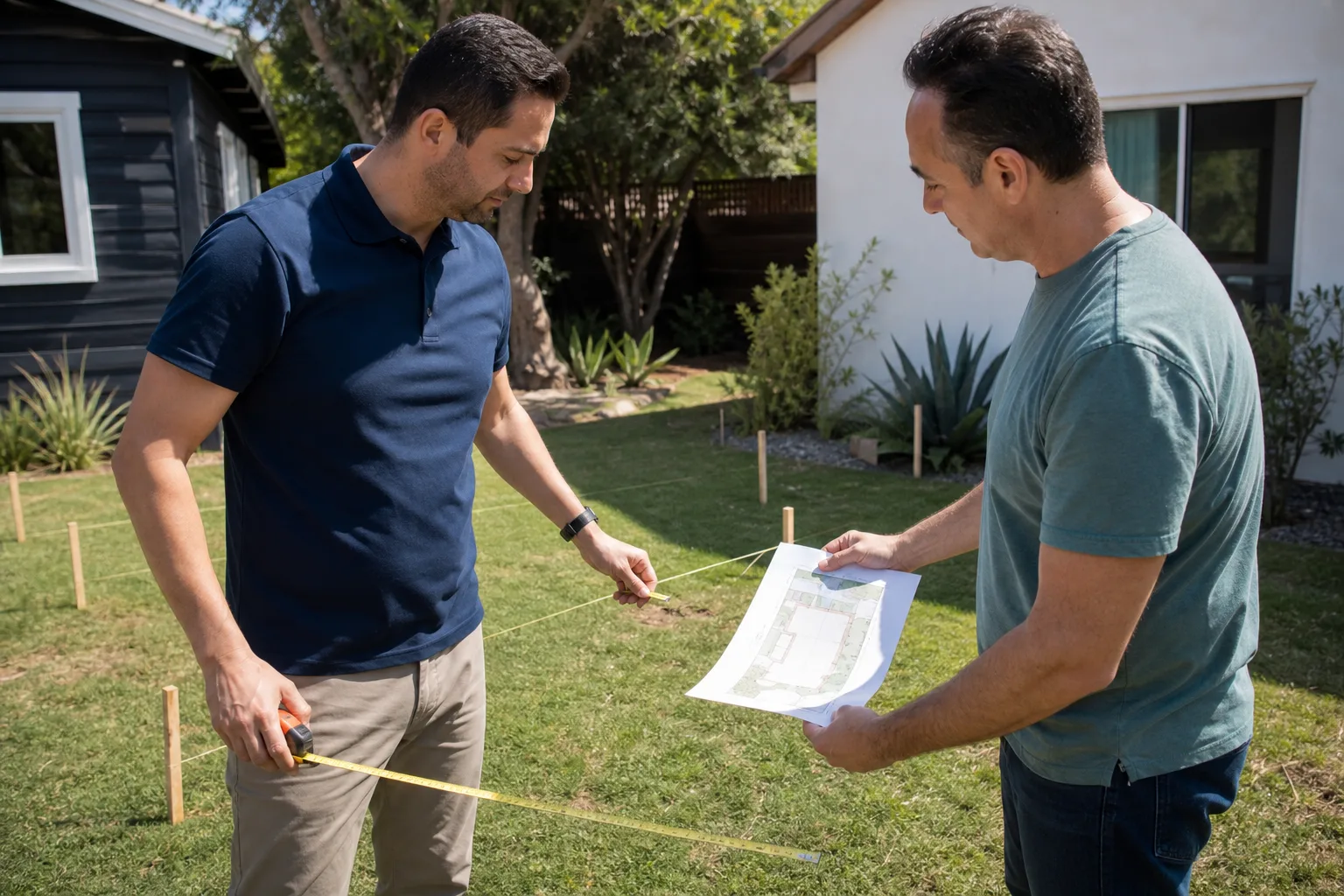
Here’s the thing about permits in Los Angeles: if you’ve never built in the city, you don’t know how the city builds. LADBS operates its own plan check system, and it is not the same as Pasadena, Burbank, Glendale, or Culver City, each of which runs its own building department with its own interpretation of the California Building Code. This matters for two reasons. First, your timeline changes depending on which jurisdiction reviews your plans. Second, a contractor who has only built in smaller San Gabriel Valley or South Bay cities may have never dealt with LADBS’s stricter seismic retrofit requirements, its more demanding energy compliance checks, or its specific submittal format.
- LADBS plan check timeline: Expect four to eight weeks for a straightforward addition, longer if the project involves structural changes, hillside work, or a second story. We tell Los Angeles homeowners to plan for the permit phase to consume a quarter of the total project timeline.
- Pasadena and Culver City: These cities have their own code enforcement philosophies. Pasadena is known for exacting architectural review in historic districts. Culver City enforces its own below-market housing rules that can affect how an addition is classified. If your contractor assumes every city behaves like the last one they worked in, your plan check will hit a wall.
- Unincorporated LA County: If your property is technically in an unincorporated pocket, you’re under LA County Public Works, not LADBS, and the submittal process, fee structure, and inspection scheduling all differ. A surprising number of homeowners don’t know which jurisdiction governs them until the first permit application gets bounced.
The practical takeaway: ask your home addition contractor a direct question, “Which of my permits will go through LADBS and which, if any, through my city’s own building department?” If they can’t answer on the spot, or they wave it off as a detail that gets sorted later, keep looking. That’s not a small detail. It’s the difference between a six-month project and a fourteen-month project.
Soft-Story, Hillside Grading, and Soil Reality Checks
Los Angeles is not flat. That’s obvious to anyone who’s driven the 405, but it becomes painfully concrete when you try to add a room on a lot that slopes, sits on a canyon edge, or backs up against a hillside. Before you draw a single wall, your contractor needs to assess what the city calls “grading” and what an engineer calls “soil bearing capacity.” Here’s why.
Soft-story conditions: In LA residential construction, a soft-story typically refers to a structure where one floor has significantly less sheer wall or bracing than the floors above. The term got famous after the Northridge earthquake for apartment buildings with tuck-under parking, but the same vulnerability shows up in houses where a new addition leaves the existing lower floor under-braced. When you add a second story to a 1950s home, the original first-floor framing often needs seismic strengthening to keep the whole building from swaying in inconsistent ways during an earthquake. LADBS plan check will catch this, and it should be in your budget from day one. Expect structural retrofit costs to run anywhere from $15,000 to $60,000 depending on the original framing.
Hillside grading: In neighborhoods like Mount Washington, Echo Park, and parts of Silver Lake, even a modest addition can trigger a grading review if the slope exceeds a certain angle or if your construction requires cutting into the hillside. A grading permit is separate from a building permit. It involves soils engineers, drainage plans, and sometimes retaining wall calculations. A contractor who rarely works hillside lots may not flag this early, and then the owner is hit with a grading permit fee and an engineer’s bill after the project is already underway.
Soil reality checks: Los Angeles has expansive clay in many flatland areas, particularly in the San Fernando Valley and parts of South LA. Expansive soil swells when wet and contracts when dry, which can crack a slab foundation if the design doesn’t account for it. The fix is usually deeper footings, post-tension slabs, or soil treatment, none of which is free. A competent Los Angeles addition contractor will pull a soils report before finalizing a foundation design, and the cost of that report (often $3,000 to $6,000) should be a line item in your written price, not a surprise.
These three factors, soft-story seismic concerns, hillside grading, and soil movement, are exactly the areas where a contractor with only tract-home experience gets into trouble. We’ve walked onto Los Angeles lots where a previous contractor’s preliminary number didn’t include any of them, and the homeowner was left with a gap between what they budgeted and what the city required.
The Owner-Builder Permit Trap (And How to Avoid It)
This is one of the most quietly dangerous corners of Los Angeles home addition work, and most homeowners never hear about it until something goes wrong. The question is simple: whose name goes on the building permit? There are two options. The contractor can pull the permit under their own state contractor’s license, or the homeowner can pull the permit as an “owner-builder.” Some contractors push the owner-builder route because it lets them shift liability. Here’s what that actually means.
When you pull a permit as an owner-builder in California, you become the legally responsible party for the entire project. You’re responsible for worker injuries. You’re responsible for code compliance. You’re responsible if a subcontractor never gets paid and files a mechanic’s lien against your property. The contractor working on your house may technically be just your employee for the duration of the build, even though they’re running the show. In Los Angeles, where the city can issue stop-work orders for permit violations, that’s a heavy liability to carry in exchange for the convenience of a faster permit.
A reputable home addition contractor in Los Angeles pulls permits under their own license. It’s slower and it exposes their work history to the city’s inspection records, but it also keeps the liability where it belongs: on the professional you’re paying. At Sutton ADU Builders, we pull permits under our own license on every project. We also hand you a written price before any work begins, which means the permit fees, the soils report, the engineering stamps, and the city’s plan check charges are all visible to you from the start. If a contractor suggests the owner-builder route and can’t give you a clear legal reason tied to your specific situation, treat it as a red flag.
Nine Questions That Expose a Contractor’s Real LA Permit Experience
You don’t need to become a building inspector to evaluate a contractor. You just need to ask questions that require specific local knowledge. A contractor with genuine Los Angeles experience answers these quickly and with examples. A contractor who has only built in Orange County or Riverside freezes, fumbles, or changes the subject.
- “Which LADBS office will handle my plan check, and how many resubmittals should I expect?” The right answer includes a specific office (Metro, Van Nuys, West LA, etc.) and a realistic resubmittal count. The wrong answer is a blank look.
- “Am I in a Very High Fire Hazard Severity Zone, and does that change my cladding choices?” If they don’t know how to check, they haven’t built in enough LA neighborhoods.
- “Does my project trigger any zoning variance, or is it a straight code-compliant addition?” A variance means public hearings and months of delay. A contractor should know which path you’re on before you pay for drawings.
- “Are there any historic preservation overlay zones on my street?” LA has dozens of HPOZs, from Angelino Heights to Carthay Circle. An addition in an HPOZ faces architectural review that a non-local contractor may never have encountered.
- “What’s your plan for the soils report?” If they say you don’t need one for a single-story addition on flat land, they might be right. If they say you never need one, they’re wrong. Los Angeles expansive soils are too common for blanket assumptions.
- “How many LADBS inspections will my project require, and who schedules them?” A genuine LA contractor can name the usual sequence: foundation, framing, shear wall, electrical rough-in, insulation, final. Someone making it up on the spot can’t.
- “Do you pull permits under your own license, and may I see your CSLB number?” No hemming. A direct yes and a verifiable number.
- “Have you built additions in my specific neighborhood cluster?” LA isn’t one city when it comes to building. Experience in Brentwood doesn’t transfer cleanly to South Gate. Ask for a nearby example.
- “What line items do you include for LADBS fees, school district fees, and plan check charges?” Los Angeles has development impact fees that can add thousands. A written price that includes them is a trust signal. A verbal estimate that ignores them is a warning.
Ask these questions in your first meeting. A contractor who’s genuine about Los Angeles work answers with specifics, not generalities. If you’d rather skip the vetting altogether, Sutton ADU Builders will walk you through each of these answers, in writing, before you commit to anything. That’s what the Threshold Standard means in practice: you know exactly who is coming to your property and exactly what they’re doing there.
What a Written Locked Price Must Contain in California
California law doesn’t mess around with construction contracts. Under the Home Improvement Contracts law, which the Contractors State License Board enforces, any home improvement project over $500 requires a written contract with specific disclosures. Most additions in Los Angeles run well into six figures, so the contract isn’t optional; it’s the only thing standing between you and a financial disaster. Here’s what a compliant written price should contain, line by line.
- Total contract price, in a fixed dollar amount. Not an estimate. Not a range with fine print. A single number you can point to. If the contractor says the number is “flexible based on conditions,” that’s not a locked price.
- A payment schedule tied to milestones, not dates. California law prohibits a contractor from collecting more than 10% or $1,000 (whichever is less) as a down payment. Payments should follow completed milestones: permit issuance, foundation, framing, rough-in, final inspection. Never pay the full balance before the final inspection passes.
- Scope of work described in plain language. What is being built, what materials are specified, and what is excluded. Vague phrases like “as needed” or “per code” without further detail invite disputes later.
- Permit and inspection line items. LADBS fees, plan check charges, and school district fees are predictable, and they should appear as specific allocations in the contract. If they’re buried in a lump sum, ask for the breakdown.
- A change order procedure. The contract should state that any change to the scope requires a written change order signed by both parties before the work is performed. No verbal changes, no “we’ll sort it out later.”
- Completion date or timeline, with allowance for permit delays. A reasonable contractor gives a range based on permit timelines, not a promise of “three months” that assumes LADBS moves at suburban speed.
- Warranty terms in writing. What’s covered, for how long, and what the contractor will do if something fails. At Sutton, the 365-Day Done Right Promise is printed on the contract, not conveyed in a handshake. If the work isn’t right within one full year of project completion, we make it right. A free second visit is part of that, no haggling required.
If a contractor hands you a one-page bid with a number scrawled at the bottom and says “that’s all you need,” they’re not just skipping paperwork; they’re skipping the protections California law was built to give you. Los Angeles homeowners deserve better. The Sutton ADU Builders home office has seen the aftermath of contracts that weren’t specific enough, and it’s never pretty.
Prefab and Modular Options: When They Make Sense in LA
Los Angeles is one of the few American cities where prefab and modular additions actually pencil out, and part of that is bureaucratic. Prefab panels from companies like Abodu and Cover arrive with factory-built framing and pre-engineered structural drawings, which can shave weeks off LADBS plan check. A conventional stick-built addition requires your architect or engineer to draw every beam and shear wall from scratch. A prefab system arrives with those calculations already stamped, which is why some Los Angeles homeowners see plan check drop from eight weeks to four.
That said, prefab is not automatically cheaper. A Dvele or Mighty Buildings unit can command a premium because of the automation, precision, and reduced waste, and not every LA lot can accept a factory-built module. Narrow streets in older neighborhoods sometimes make crane placement impossible. Hillside lots can make the foundation and transport costs spike. The right approach is to evaluate prefab against conventional construction on your specific lot, with real numbers, not brochure gloss.
Sutton ADU Builders has direct experience working with these product lines, so when a homeowner comes to us weighing a conventional addition against a prefab module, we can lay out the trade-offs honestly. Sometimes prefab is faster and cleaner. Sometimes a conventional build gives you more flexibility for the same money. The point is that Los Angeles has real choices now, and the ADU Builders in Los Angeles who understand both worlds can help you sort them.
Common Mistakes to Avoid
- Signing before verifying the CSLB license. The Contractors State License Board keeps a public database. Check it. A contractor with an expired or suspended license can’t legally pull permits in Los Angeles, and your project stalls before it starts.
- Ignoring the difference between LADBS and your local jurisdiction. Assuming every city in the LA basin processes permits the same way is how six-month projects become year-long projects. Confirm the jurisdiction before you hire.
- Skipping the soils report to save money. A $4,000 soils report might seem like a cost to avoid, but expansive clay in the Valley will crack a foundation built without one. The repair costs five times the report.
- Accepting a verbal estimate as a locked price. If it’s not in writing with a fixed dollar amount and a change order clause, it’s not a contract. It’s a conversation.
- Letting the contractor pull the permit as an owner-builder. It shifts legal liability to you. Don’t do it unless a real estate attorney has reviewed your specific situation and approved it in writing.
- Under-budgeting for LADBS fees and school district charges. Los Angeles development fees are not optional, and they can add $10,000 to $30,000 to a project depending on scope and location. Ask for them as line items.
- Prioritizing speed over permit compliance. Unpermitted work saves time now and costs you at resale. In Los Angeles, where buyer inspections are thorough, unpermitted square footage can kill a sale.
When to Call a Professional
Some home improvement projects are genuinely DIY-able. A room addition in Los Angeles is not one of them. The permits alone require stamped drawings, structural calculations, and an energy compliance report. The actual construction involves foundation work, framing, electrical, plumbing, and a sequence of city inspections that will fail if the work isn’t done to code. If your addition touches load-bearing walls, uses gas or electrical work, sits on a sloped lot, or adds a second story, you need a licensed contractor with Los Angeles-specific experience, not a handyman with a truck.
If you’re considering a home addition or detached ADU in Los Angeles, Sutton ADU Builders’ home addition contractor service in Los Angeles offers free estimates. Call (472) 248-8213 and we’ll walk through your lot, your timeline, and your budget in plain language, with a written price before any work begins.
Frequently Asked Questions
Most home additions in Los Angeles run $250 to $550 per square foot depending on scope, site conditions, and finish level, so a 400-square-foot room addition typically lands between $100,000 and $220,000. Site work, soils reports, LADBS fees, and seismic retrofits add cost beyond the base square footage. Call (472) 248-8213 for a written estimate specific to your Los Angeles lot, it’s free.
Plan check at LADBS takes four to eight weeks for a straightforward addition, and four months or more for a hillside or second-story project. Surrounding cities like Pasadena and Culver City operate on their own timelines, which is why confirming the permit jurisdiction early is critical. A written timeline should account for plan check, resubmittals, and inspection scheduling.
In many Los Angeles neighborhoods, yes, especially in the San Fernando Valley and other areas with expansive clay soil. A soils report typically costs $3,000 to $6,000 and determines whether your foundation needs deeper footings, post-tension slabs, or soil treatment. Skipping it to save money is a false economy.
An owner-builder permit puts the legal and financial liability on you, including worker injuries and mechanic’s liens. A contractor who pulls permits under their own license keeps that liability where it belongs: with the professional doing the work. In Los Angeles, where inspection records and stop-work orders are real, we recommend the contractor always pull permits under their own license.
Sometimes, yes. Prefab systems from companies like Abodu and Cover arrive with pre-stamped engineering, which can reduce LADBS plan check time by several weeks. But prefab is not automatically cheaper or faster on every lot, and narrow hillside streets can complicate delivery. The right answer depends on your specific property.
It shouldn’t, if your contract is written according to California Home Improvement Contract law. A fixed price with a clearly defined scope and a written change order process keeps the number stable. At Sutton ADU Builders, we deliver a written price before any work begins, and the 365-Day Done Right Promise is printed right on the contract. Call (472) 248-8213 for an exact quote.
The Bottom Line
Hiring a home addition contractor in Los Angeles is a test of local knowledge. The contractor who navigates LADBS without flinching, knows the difference between owner-builder and contractor-pulled permits, accounts for expansive soil and hillside grading, and puts a fixed price in writing is the contractor who finishes your project. The contractor who waves off permits, pushes speed, and hands you a vague estimate is the one who leaves you with an unpermitted addition that surfaces at the worst possible moment. If you want a name, a face, and a written price before anyone picks up a tool, Sutton ADU Builders’ room addition service in Los Angeles is ready to walk your lot and give you honest numbers. The name Sutton comes from the old English for a south farm, a settled, rooted decision. Adding a second home to your lot is exactly that kind of decision, and it deserves a contractor who treats it that way.
Written by Miles Hartwell, Owner at Sutton ADU Builders, serving Los Angeles since 2006. Explore more guides & resources on our blog.